The following was first published in Wales Arts Review, Volume 3, Issue 12, June 2014.
‘The mission of Tŷ Cerdd – Music Centre Wales
is to support, develop and promote the creation, performance and
empowering experience of music, both in and of Wales. In so doing, we
aspire to reach people in local communities, nationally and
internationally, promoting excellence through vision, participation and
training … Tŷ Cerdd – Music Centre Wales brings a world of music to
Wales and the music of Wales to the world.’
Wales has long prided itself on being a nation of bards and singers,
poets and musicians. From full-throated Valleys choirs to finespun
yearnings of the triple harp, music, it seems, like a love of language,
is in the national soul – and its passionate sharing in chapel and
beyond has helped bind communities together through good times and bad
for countless generations. You might think, then, that the Land of Song
would take care to celebrate its composers and afford them every
opportunity to grow, develop and, well, be heard. But no, here as
elsewhere, Wales’s ‘classical’ composers (for want of a better term) –
especially those writing outside cosy conceptions of Welsh music – often
struggle to be taken seriously beyond a small circle of enthusiasts.
Few Welsh or Wales-based composers either dead or living are familiar
figures within our borders, never mind further afield. Performances are
hard to come by, and only a handful of composers get the chance to
develop an audience for their own or others’ work.
Generating a profile for Welsh composers of all stylistic stripes is
obviously an important key to wider cultural recognition and there is no
reason why being a small nation (relatively speaking) should pose a
hindrance on the international stage. Witness the success of the Baltic
States and Scandinavia for instance; Estonia, Latvia and Lithuania each
have fantastic archive and resource hubs, which work together to promote
their nations’ composers under the aegis of the Baltic Music
Information Centre – whilst the eagerness of the Finnish Music
Information Centre to shower would-be programmers worldwide with scores
and recordings is legendary in new music circles.
Here in the UK, we have struggled to set up an equivalent promotional resource. Scotland
has arguably been best served to date, but in recent times – especially
in an era of massive cuts to public funding – the overall picture has
not been pretty. In 2008, Sound and Music
was set up as an umbrella organisation, replacing the onetime Society
for the Promotion of New Music and re-siting its records arm, the
British Music Information Centre, to Huddersfield University Library; a
move which promised expert re-organisation of the archive, but which has
so far hardly served to improve its general accessibility. An
embarrassingly public furore
over the running of SAM in 2012 has prompted renewed vigour and
purpose, however, and whilst it is too early to tell whether this will
lead to a permanent opening of doors for composers or audiences, the
signs are promising, with a wide expansion of creative opportunities and
an increased engagement with the public regarding different kinds of
contemporary music.
In Wales, Tŷ Cerdd has existed for over forty years (joining the
newly-formed International Association of Music Information Centres in
1986). It has done much excellent work, particularly in the field of
amateur music-making, with some 300 affiliated societies and ensembles
nationwide.* But, as far as many Welsh composers are concerned, up until
very recently, Tŷ Cerdd too had for some time been in dire need of
overhaul. So the appointment of the determined and enterprising Gwyn L.
Williams as director and all-round new broom in 2013 prompted a surge of
hope for the future. Indeed, since Williams’s appointment, Tŷ Cerdd is
already beginning to repay that optimism, with moves at last to
establish a serious national centre for Welsh musicians and composers
alike from its offices and very well-regarded recording studio based at
the Wales Millennium Centre in Cardiff.
Hearteningly, the number of exciting projects and initiatives offered
by Tŷ Cerdd for composers as well as performers is growing, with
commissions (like that of Mervyn Burtch
for a recent Dylan Thomas celebration by the BBC National Orchestra of
Wales) and education outreach work being redoubled alongside efforts to
organise and make properly available a huge archive of Welsh scores and
recordings going back many years, and to which composers living and
working in Wales are invited to contribute. Obviously, new digital and
online technology is opening vast new possibilities in terms of
promotion and dissemination of music and information, and Williams is
keen to take advantage on all levels in order to ‘bring the music of
Wales to a world audience.’
So far, Williams’ most striking and ambitious project to bear fruit
is the creation of a new record label, Tŷ Cerdd Records, which was
launched on June 5 at the Wales Millennium Centre. Designed to
complement Tŷ Cerdd’s main function as a ‘one-stop shop’ for composers,
performers, promoters and so on, the label builds on the ongoing success
of Tŷ Cerdd’s recording studio, and will encompass old and new pieces
written by Welsh composers or performed by Welsh musicians based in
Wales. As well as existing works and new commissions, the label will
feature re-mastered works from archival recordings including those held
at the Welsh Music Archive at Tŷ Cerdd, with revenue generated from
sales to be reinvested in Welsh music.
The debut recording was released on the day of the launch. Bagatelles,
by Daniel Jones and Béla Bartók, is performed by the brilliant and much
loved international concert pianist Llŷr Williams. It is the first
commercial recording of Jones’ affecting and unashamably ‘old-fashioned’
take on this quietly potent form, featured here alongside the spikier,
more intense legacy of the elder Hungarian (Bartók’s Bagatelles
were composed in 1908. Coincidentally, he also visited Wales – in 1922
to perform in a concert, staying at the then home of the English
composer Peter Warlock in Montgomeryshire). Jones wrote three sets of
bagatelles, respectively from 1943-5, 1948-53 and in 1955, comprising 24
pieces in all – and this CD includes a further two hitherto
unpublished.
The four remaining discs in this initial batch from Tŷ Cerdd will
encompass a variety of genres and performers, and are due to be released
as follows this year:
Seven Poems of Stillness by Hilary Tann, will be released during the Gregynog Festival
(on now until June 29). Performed by cellist Guy Johnston, it will
include archive recordings of R.S. Thomas reading his own poetry.
Songs of Wales, performed by the celebrated Welsh tenor Stuart Burrows, will be released at the National Eisteddfod
in Llanelli on August 4. The disc comprises previously unheard and
important analogue recordings by Burrows, digitally re-mastered at Tŷ
Cerdd to ensure their survival and to make them available through the
label.
Under Milk Wood: an Opera. John Metcalf’s newly composed operatic adaptation of Dylan Thomas’ radio play will be released on October 27; the exact centenary of the iconic poet’s birth.
Continuing the Dylan Thomas celebrations and more, a disc of William
Mathias’ music will include a performance of the composer’s setting of
Thomas’s Ceremony After a Fire Raid and his Piano Concerto No. 2, recently recorded live
by pianist Llŷr Williams and the BBC National Orchestra of Wales under
Grant Llewellyn. This CD will be released in November when Mathias (who
died far too young in 1992) would have turned 80, and to mark the 100th
anniversary of the start of the First World War.
Tŷ Cerdd Records is a laudable and exciting venture, with an
impressive spread so far of new and old pieces across a range of genres
and more approachable styles. If the twin excellence of Llŷr Williams’
performance and the production quality of this first solo piano disc is
anything to go by, listeners are in for a treat – as well as the
opportunity to learn more about some unduly neglected Welsh composers
past and present.
Perhaps it is unrealistic to expect any ‘new music’ composer to
become a household name these days, as so many people labour under the
misapprehension that new music is ‘difficult’ or obscure or – worse –
elitist. Certainly it can sound unfamiliar – and perhaps the music of
the twentieth century even more so. But surely that is something to
rejoice in a time of unrelenting, bland celebrity? In any case, new
music can hugely repay a curious listen, and speak directly to our lives
in all their mystery and mundanity. Not just the general public and the
media, however, but the classical music establishment can suffer from
certain types of, shall we say, cultural obstinacy. Overcoming
parochialism on the one hand and enthrallment to fashion on the other
are just two challenges from all sides which lie ahead for Tŷ Cerdd in
promoting Welsh composers at home and abroad. It is not an easy task,
but I’m sure it can be done, and much is riding on Tŷ Cerdd’s success
for the future of music in Wales.
*representing some 22,000 performers and assisting with grants and
advice. Tŷ Cerdd also founded and manages the National Youth Jazz and
National Youth Wind Orchestras of Wales, the National Youth Brass Band,
National Youth Choirs, and runs the Young Composers project. The
organisation is a registered charity funded by the Arts Council of
Wales, the Welsh Assembly Government and the PRS Foundation.
About Me

- steph power
- Twitter: @spower_steph, Wales, United Kingdom
- composer, poet, critic, essayist
Monday, 9 March 2015

Sunday, 8 March 2015
Atmospheres New Music Festival: Two Operas and an Oratorio by graduating composers at the Royal Welsh College of Music and Drama 2014
The following was first published in Wales Arts Review Volume 3, Issue 11, May 2014.
Royal Welsh College of Music and Drama, Richard Burton Theatre, Dora Stoutzker Hall, May 13.
The Pin Drops
Words and music by David Harrington
The Man, the Corpse and the Soldier
Words and Music by Lewis Furber
Singers/actors: Conal Bembridge-Sayers / David Harrington / Katrina Nimmo / Lei Roberts – presented by Marjorie’s Hat Box
Musicians of the Royal Welsh College of Music and Drama
Conducted by Jack Lovell
Oratorio
Bhava
Words and music by Ben Lunn, from ancient Buddhist texts.
Singers and musicians of the Royal Welsh College of Music and Drama
Conductor: Ben Lunn

‘Warning: very strong language and upsetting themes’.
I confess my heart sinks whenever I’m presented with such cautions before a performance. Not because I’m easily shocked – I’m quite the reverse. But rarely does it turn out to signal genuinely disturbing, or even thought-provoking, content – and, in any case, generally speaking I don’t believe we should be warned of that in art, because it infantilises the audience. Challenging taboos and investigating dark areas of human experience are vital and serious functions of art in any culture, including through comedy.
But depressingly often, the warning merely turns out to mean a dialogue peppered with ‘fucks’ and ‘cunts’ (hardly shocking), and action containing violence and/or sex of some graphic variety designed for cosmetic impact. I’ve no objection to either per se, but if those are the sole attractions, I’m likely to become bored, as I did in David Harrington’s The Pin Drops, staged as part of Atmospheres New Music Festival: a day-long showcase of work by graduating composers from the Royal Welsh College of Music and Drama. In Harrington’s story, an abused and aging opera singer – the valiant and capable Katrina Nimmo – kills and eats her offensive husband and then her lover. Interestingly, the woman-on-man violence happened largely off-stage. We can enjoy watching women being abused and humiliated, but not their men-folk it seems.
According to the blurb, this piece (and the far more thoughtful, yet hardly insipid, The Man, the Corpse and the Soldier, by Lewis Furber) were an ‘innovative hybrid form of shock and music theatre’ which aimed to ‘thrill and arouse the minds of a modern audience so bombarded by dreary formulaic blockbusters and low-brow media’. Exactly what this means I’m not sure – and I suspect (or hope) that whoever wrote it did not intend ‘low-brow’ to denote cultural inferiority. But empty narrative gestures by way of rape and physical violence leave me cold; especially when, as in Harrington’s piece, the characterisation relies on gender cliché and casual voyeurism – and Harrington can no longer plead student in mitigation. At any rate, I find that people who have lived experience of ‘upsetting themes’ rarely go on to present them as titillation for others. Musically, Harrington’s pastiche cabaret and show tunes were certainly enjoyable, and elements of his theatre were effective, even amusingly done in places – the diva’s direct addressing of the audience early on, for example. But I’d look elsewhere for truly adult themes.
…Such as – by way of illustration – Welsh National Opera’s recent staging of Puccini’s Manon Lescaut. This was a production which induced a kind of moral panic in some audience members, with its scenes of sexual slavery, scantily-clad prostitutes and twisted, mafioso thuggery (the production raised other objections too, but that’s a different debate). The point is, director Mariusz Treliński devised those scenes precisely to show a conjunction between sex, money and power, and the hypocrisy of a society – ours today, as much as Puccini’s, or Prévost’s (from whom his libretto came) – in which women like Manon are literally created by men to be fantasies or ‘luxury toys’. How far Treliński’s staging succeeded is moot – and whether his singing actors were up to the task. But his intention was far from perversity for its own sake, or to glamourise sexual violence; rather, to take an intelligent look at deep-seated social problems caused by the clash of moral values with opposing fears and desires.
Thankfully, the second opera on this Atmospheres double bill, The Man, the Corpse and the Soldier, showed real promise in that regard. Lewis Furber’s subject encompassed male rape, homophobia, racism, murder and mental disintegration – and he managed not to be glib about any of them, despite that gleeful rhetoric of the programme note. In Furber’s story, utilising the same set as Harrington’s (a room in a flat, with the instrumental ensemble part-hidden up stage), the Man strangles his male lover but tries to continue living as normal alongside the corpse, mentally unravelling until his own demise at the hands of a psychopathic soldier. Lei Roberts showed real torment, loss and self-hatred in the main role, which demanded he alone hold the audience for long stretches (too long, actually, between the initial murder and the soldier’s appearance). Furber’s stagecraft and dramatic sense will doubtless develop as he gains experience, but his basis was sound and his characters had substance. Above all, Furber’s music was both inventive and expressive of the Man’s inner twists and turns (the subtle use of electric guitar and percussion being one of many highlights). Conductor Jack Lovell navigated his impressive band with aplomb through this and Harrington’s score.

That said, this is an admirably ambitious and broadly successful work, and Lunn, who conducted the première, did well in coaxing sustained commitment from his assembled RWCMD volunteers: a chamber choir, plus nine-piece ensemble with an emphasis on resonant, deep toned and percussive sounds. The instrumental line-up, as well as Lunn’s use of vocal chant and declamation, clearly reflects his inspiration in Tibetan ritual music. There was some extremely effective writing for the bassoon and trombone in particular, with echoes of shawm and rag-dun. Cello, double bass, harp and organ also featured alongside thundering bass drum and tom toms, tam tams and ringing crotales to create an evocative and colourful sound world with some great, crashing climaxes. An added piano jarred somewhat timbrally – and sheer volume overpowered the choir in places. But the singers coped impressively with some high tessitura lines and their pitching was accurate and diction clear for the most part.
Lunn quoted further influences in his biographical note, from Bataille to Perotin and, of contemporary composers, Rădulescu, Pärt and the late Jonathan Harvey. It was this last who felt most present here – in spirit more than through direct musical allusion, but clearly so in the delicately ethereal Bhava I, for instance. This sole instrumental section was inspired by a comparison between the blossoming lily in the pond and the idea of enlightenment. Bhavas II-IV were based on Tibetan texts: respectively an excerpt from the Tibetan Book of the Dead, the ‘100 Syllable Mantra’ and ‘Om Mani Padme Hum’.
It wasn’t clear from the programme note how far the religious meaning of these texts is, in itself, important to Lunn – and perhaps that doesn’t matter. Clearly, he has been moved by them, and the larger wisdom they represent, to urge his audience to greater awareness of matters spiritual, ancient and modern. The result is a work that is as heartfelt as it is thoughtful, and which signals an interesting turn to a more tonal language for its composer. My one caution going forward would be to guard against a too-literal adoption of non-western music styles. Bhava manages to avoid that – just – with its co-inspiration in 11th century organum. But the line between celebrating another culture and appropriating it is sometimes a fine one.
Royal Welsh College of Music and Drama, Richard Burton Theatre, Dora Stoutzker Hall, May 13.
In-Your-Face Opera Double Bill:
Words and music by David Harrington
The Man, the Corpse and the Soldier
Words and Music by Lewis Furber
Singers/actors: Conal Bembridge-Sayers / David Harrington / Katrina Nimmo / Lei Roberts – presented by Marjorie’s Hat Box
Musicians of the Royal Welsh College of Music and Drama
Conducted by Jack Lovell
Oratorio
Bhava
Words and music by Ben Lunn, from ancient Buddhist texts.
Singers and musicians of the Royal Welsh College of Music and Drama
Conductor: Ben Lunn
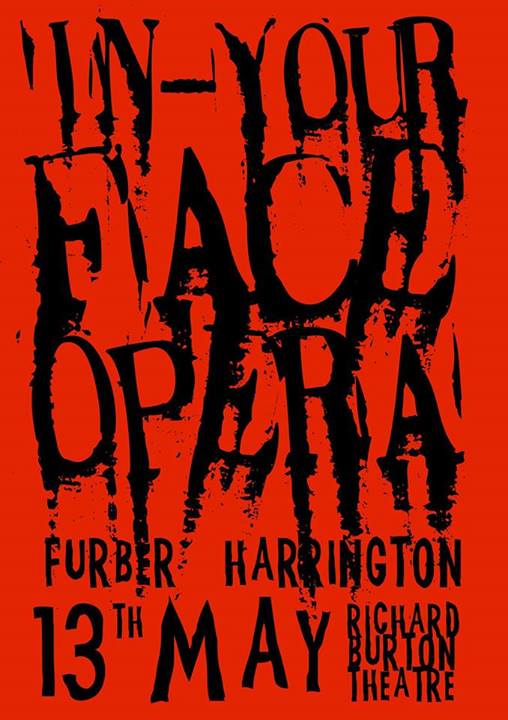
Design by
Marjorie’s Hat Box
Marjorie’s Hat Box
‘Warning: very strong language and upsetting themes’.
I confess my heart sinks whenever I’m presented with such cautions before a performance. Not because I’m easily shocked – I’m quite the reverse. But rarely does it turn out to signal genuinely disturbing, or even thought-provoking, content – and, in any case, generally speaking I don’t believe we should be warned of that in art, because it infantilises the audience. Challenging taboos and investigating dark areas of human experience are vital and serious functions of art in any culture, including through comedy.
But depressingly often, the warning merely turns out to mean a dialogue peppered with ‘fucks’ and ‘cunts’ (hardly shocking), and action containing violence and/or sex of some graphic variety designed for cosmetic impact. I’ve no objection to either per se, but if those are the sole attractions, I’m likely to become bored, as I did in David Harrington’s The Pin Drops, staged as part of Atmospheres New Music Festival: a day-long showcase of work by graduating composers from the Royal Welsh College of Music and Drama. In Harrington’s story, an abused and aging opera singer – the valiant and capable Katrina Nimmo – kills and eats her offensive husband and then her lover. Interestingly, the woman-on-man violence happened largely off-stage. We can enjoy watching women being abused and humiliated, but not their men-folk it seems.
According to the blurb, this piece (and the far more thoughtful, yet hardly insipid, The Man, the Corpse and the Soldier, by Lewis Furber) were an ‘innovative hybrid form of shock and music theatre’ which aimed to ‘thrill and arouse the minds of a modern audience so bombarded by dreary formulaic blockbusters and low-brow media’. Exactly what this means I’m not sure – and I suspect (or hope) that whoever wrote it did not intend ‘low-brow’ to denote cultural inferiority. But empty narrative gestures by way of rape and physical violence leave me cold; especially when, as in Harrington’s piece, the characterisation relies on gender cliché and casual voyeurism – and Harrington can no longer plead student in mitigation. At any rate, I find that people who have lived experience of ‘upsetting themes’ rarely go on to present them as titillation for others. Musically, Harrington’s pastiche cabaret and show tunes were certainly enjoyable, and elements of his theatre were effective, even amusingly done in places – the diva’s direct addressing of the audience early on, for example. But I’d look elsewhere for truly adult themes.
…Such as – by way of illustration – Welsh National Opera’s recent staging of Puccini’s Manon Lescaut. This was a production which induced a kind of moral panic in some audience members, with its scenes of sexual slavery, scantily-clad prostitutes and twisted, mafioso thuggery (the production raised other objections too, but that’s a different debate). The point is, director Mariusz Treliński devised those scenes precisely to show a conjunction between sex, money and power, and the hypocrisy of a society – ours today, as much as Puccini’s, or Prévost’s (from whom his libretto came) – in which women like Manon are literally created by men to be fantasies or ‘luxury toys’. How far Treliński’s staging succeeded is moot – and whether his singing actors were up to the task. But his intention was far from perversity for its own sake, or to glamourise sexual violence; rather, to take an intelligent look at deep-seated social problems caused by the clash of moral values with opposing fears and desires.
Thankfully, the second opera on this Atmospheres double bill, The Man, the Corpse and the Soldier, showed real promise in that regard. Lewis Furber’s subject encompassed male rape, homophobia, racism, murder and mental disintegration – and he managed not to be glib about any of them, despite that gleeful rhetoric of the programme note. In Furber’s story, utilising the same set as Harrington’s (a room in a flat, with the instrumental ensemble part-hidden up stage), the Man strangles his male lover but tries to continue living as normal alongside the corpse, mentally unravelling until his own demise at the hands of a psychopathic soldier. Lei Roberts showed real torment, loss and self-hatred in the main role, which demanded he alone hold the audience for long stretches (too long, actually, between the initial murder and the soldier’s appearance). Furber’s stagecraft and dramatic sense will doubtless develop as he gains experience, but his basis was sound and his characters had substance. Above all, Furber’s music was both inventive and expressive of the Man’s inner twists and turns (the subtle use of electric guitar and percussion being one of many highlights). Conductor Jack Lovell navigated his impressive band with aplomb through this and Harrington’s score.
*
Design by
Going stylistically and thematically from chalk to cheese, the next (and final) item on the Atmospheres agenda was Ben Lunn’s Bhava,
described by the composer as an ‘oratorio-like work’. Lunn’s title
refers to a Buddhist concept of the continuous cycles of life, death and
reincarnation, and the four sections of his piece are, appropriately
enough, designed to be performable in any order ‘and still make musical
and narrative sense’. The musical material is strong, and I see no
reason why this flexibility shouldn’t work in practice – possibly
because the piece has, in fact, no narrative in conventional linear
story terms. Rather, each section is an exposition of, or reflection on,
a certain Buddhist theme. But whatever the section order, the work
could benefit from some judicious editing in places to mitigate a slight
sense of losing one’s way within its hour-long span.
Sierra Goldberg
That said, this is an admirably ambitious and broadly successful work, and Lunn, who conducted the première, did well in coaxing sustained commitment from his assembled RWCMD volunteers: a chamber choir, plus nine-piece ensemble with an emphasis on resonant, deep toned and percussive sounds. The instrumental line-up, as well as Lunn’s use of vocal chant and declamation, clearly reflects his inspiration in Tibetan ritual music. There was some extremely effective writing for the bassoon and trombone in particular, with echoes of shawm and rag-dun. Cello, double bass, harp and organ also featured alongside thundering bass drum and tom toms, tam tams and ringing crotales to create an evocative and colourful sound world with some great, crashing climaxes. An added piano jarred somewhat timbrally – and sheer volume overpowered the choir in places. But the singers coped impressively with some high tessitura lines and their pitching was accurate and diction clear for the most part.
Lunn quoted further influences in his biographical note, from Bataille to Perotin and, of contemporary composers, Rădulescu, Pärt and the late Jonathan Harvey. It was this last who felt most present here – in spirit more than through direct musical allusion, but clearly so in the delicately ethereal Bhava I, for instance. This sole instrumental section was inspired by a comparison between the blossoming lily in the pond and the idea of enlightenment. Bhavas II-IV were based on Tibetan texts: respectively an excerpt from the Tibetan Book of the Dead, the ‘100 Syllable Mantra’ and ‘Om Mani Padme Hum’.
It wasn’t clear from the programme note how far the religious meaning of these texts is, in itself, important to Lunn – and perhaps that doesn’t matter. Clearly, he has been moved by them, and the larger wisdom they represent, to urge his audience to greater awareness of matters spiritual, ancient and modern. The result is a work that is as heartfelt as it is thoughtful, and which signals an interesting turn to a more tonal language for its composer. My one caution going forward would be to guard against a too-literal adoption of non-western music styles. Bhava manages to avoid that – just – with its co-inspiration in 11th century organum. But the line between celebrating another culture and appropriating it is sometimes a fine one.
Saturday, 7 March 2015
Vale of Glamorgan Festival 2014 2/2: Two Concerts by BBC National Orchestra of Wales
The following is the second of two reports from the 2014 Vale of Glamorgan Festival, first published in Wales Arts Review, Volume 3, Issue 11.
BBC Hoddinott Hall, Cardiff, 14 May:
Works by Tarik O’Regan / Xiao Ying / Huw Watkins / Duncan Ward
Pipa – Cheng Yu / Flute – Adam Walker / Narrator – Simon Callow / Conductor – Duncan Ward
St David’s Hall, Cardiff, 17 May:
Works by John Tavener
With the BBC National Chorus of Wales
Cello – Guy Johnston / Cello – Josephine Knight / Soprano – Elin Manahan Thomas / Tenor – Nicholas Mulroy / Conductor – David Atherton
This is the second year in succession that the Vale of Glamorgan Festival has been able to programme two concerts by the BBC National Orchestra of Wales – one apiece around each of the festival’s two featured composers. In 2014, these were Tarik O’Regan and the late John Tavener, for whose culminating tribute at St David’s Hall (May 17), forces were expanded further to include the BBC National Chorus of Wales in a performance of his earth-shaking Requiem of 2007. But the first orchestral concert, at Hoddinott Hall (May 15), proved no smaller in ambition. Here, in a diverse, meaty programme, vigorously conducted by Duncan Ward, we heard two recent works by O’Regan and pieces by a further three composers, including the young Xiao Ying from China.
Ying’s enigmatic The Cloud on the Wishful Side won first prize at a 2013 international competition held in Beijing, at which the VOG Festival Artistic Director, John Metcalf, was invited to adjudicate. The chief judge on that occasion was the composer Qigang Chen, who himself had a piece performed by the BBC NOW at the Vale last year. As it happens, both Chen and Ying also have footholds in France, and Ying’s piece – like Chen’s Enchantements oubliés – certainly bears the impressionist traces. Yet the younger man’s work has the greater virtue of being downright odd. Yes, there are lush added-note harmonies and a dipping into pentatonicism, but these are combined with bold, quirky effects, from the musical – major chords startling out of the blue – to the visual – violin bows waving in the air. Such gestures, and the introduction of a traditional Chinese pipa or fretted lute (played by Cheng Yu) into the orchestra, lent an intriguingly surreal east-west flavour to the five-movement work.
Before that, O’Regan’s Latent Manifest opened the concert with satisfying oomph. This is a short BBC Proms commission from 2010 exploring the illusions and allusions suggested by Bach’s solo violin writing; specifically the ‘hidden harmonies and textures’ of the Sonata No. 3 in C Major (BWV 968). The result is a highly atmospheric sound world entirely different from Bach – if anything, perhaps fleetingly suggestive of John Adams, but ultimately very much O’Regan’s own. From lovely textures exploring major-minor sonorities to cross-accented string passages and swirling melodic figures, the writing is deft and thoughtful, and the placing of a solo violin (Associate Leader Nick Whiting) next to the tuba at the back of the orchestra made for an evocative ‘question and answer’ with the orchestra’s leader (Lesley Hatfield).
Huw Watkins’ Flute Concerto (2014) came hotfoot from its Barbican world première in February, and was performed here by the extraordinary Adam Walker, for whom it was commissioned. Cast in three conventional movements, fast-slow-fast, encompassing sonata and rondo forms, this is a substantial contribution to the repertoire, and showcases Watkins’ fine craftsmanship and ear for orchestral writing as much as the virtuosic capabilities of the flute. Walker’s lithe, agile expertise is astonishing, and he was rewarded with a part both elegant and stretching, wonderfully supported here by a BBC NOW on sparkling form. The work is intricately wrought throughout, with a profusion of melodic invention, rhythmic drive and an impressive attention to motivic detail in its bubbling undercurrents.
Watkins is a musician of prodigious talent (and born in Wales to boot); not ‘just’ a composer, but an internationally-acclaimed pianist. Similarly, Duncan Ward is not ‘just’ an emerging conductor but an award-winning composer, whose short ‘psychedelic dreamscape’, Fumes, opened the second half. This is a busy, more recognisably familiar ‘new music’ piece replete with slap pizzicatos, jazzy syncopations, brassy outbursts and the like. It proved a fun warm-up, though, to the main event: O’Regan’s Suite from the Heart of Darkness taken from the 2011 opera based on the brooding Joseph Conrad novella (with a libretto by Tom Phillips).

The twice Grammy-nominated O’Regan has a long-established reputation
for exquisite, finely controlled choral works, but in fact, he works in
many genres from the purely instrumental to ballet, dividing his time
between New York and his native UK. His opera Heart of Darkness
attracted a good deal of critical interest on its première at the
Linbury Studio, Covent Garden, and the orchestral suite extracted from
it combines vivid orchestral writing (apparently, with very little
deviation from the original opera score) with a tersely dramatic part
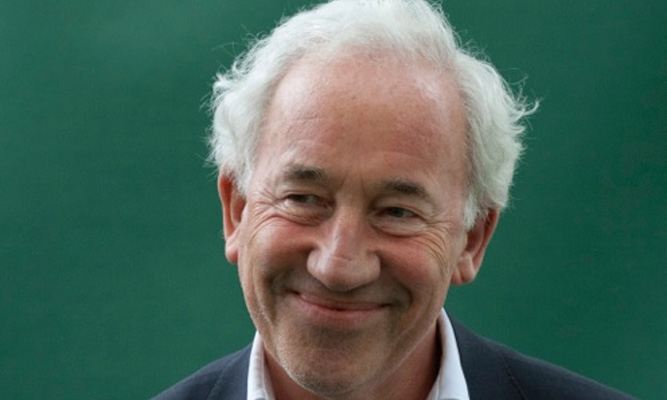
for solo narrator; here the redoubtable Simon Callow, mic’d up and
placed within the orchestra.
As ever, O’Regan has given much thought to his compositional approach. Together with Tom Phillips – and notwithstanding the almost Stravinskyan primitivism of some of his music – he seeks not to explore an ethnographic landscape, but rather to tell a story about storytelling. Suites extracted from operas can sound like mere advertisement for the main event, but this piece stands in its own right; memory, lie, confession and, of course, Colonel Kurtz’s famous exposition of ‘the horror’, all feature in a fascinatingly chameleon score with a disquieting sense of the moral ambiguity in Conrad’s dark, colonialist vision.

Whilst more telling in choral works such as Accallam na Senórach: an Irish Colloquy
than in these particular two scores, O’Regan has cited John Tavener as
an important personal influence. Indeed, O’Regan’s so-called ‘holy
minimalist’ forerunner has garnered huge respect and appreciation from
myriad fellow composers world-wide – if not necessarily from those of a
more belligerent modernist persuasion. Irritating though it may be for
these latter, Tavener’s music has touched audiences in their millions,
belying the myth that ‘classical’ music – never mind overtly sacred
music – is something beyond the reach or understanding of ‘ordinary’
people. The Protecting Veil marked a watershed in that regard
for many on its BBC Proms première in 1989, and it has since become one
of the most beloved of late 20th century pieces.
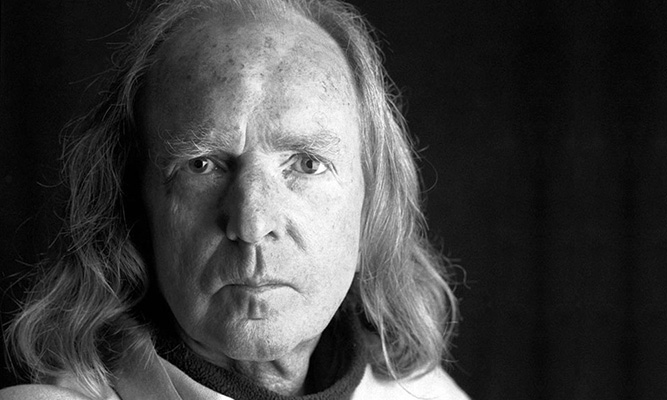
The work’s reception on that debut occasion mirrored the rapture with which Tavener attempts to depict ‘the almost cosmic power of the Mother of God’. In a salute to the Christian Orthodox feast held on October 1, he embodies the Virgin Mary in a solo cello (performed in Cardiff by Guy Johnston), which ‘never stops singing’ against a soaring backdrop of orchestral strings. Such an ecstatic vision of the Virgin is said to have inspired the people of Constantinople to drive off Saracen besiegers in the 10th century – although an understanding of this underlying theology or narrative is clearly not necessary to appreciate the work’s highly charged, meditative properties.
In Cardiff, the audience certainly seemed entranced, responding with palpable warmth at the performance conclusion. Yet I found the combination of soloist and conductor – the distinguished David Atherton – uninspiring. Perhaps it was partly the sonic balance, or lack thereof, from where I was seated, but I found the performance too geometric, and lacking in tonal variation or dramatic arc – indeed, even suffering from intonation woes in places. Regardless of accuracy, this is a work which needs a kind of passionate luminosity to set it ablaze, not to mention keen idiomatic sympathy in the leavening of Tavener’s eight continuous sections. Whilst not poor per se, the performance was disappointing. The orchestra felt unusually muted and there seemed no chance of either it or Johnston sparking the hoped-for intense spiritual alchemy.
If potentially exposing simplicity marks the writing in Tavener’s The Protecting Veil, sheer terrifying mass and volume seem never far away in his later Requiem; a work which might surprise those who have consigned Tavener to some hippy dippy minimalism. Setting words from the Hindu Upanishads, the Qu’ran and Sufi texts, as well as the Roman Catholic Requiem Mass, the work is a reflection of Tavener’s belief in the oneness of all religions in teaching that ‘our glory lies where we cease to exist.’ That is, according to Tavener, ‘when one’s false self is extinguished, the true self shines forth and we have, in a way, become one with God.’ At the Requiem’s most ferocious points, this felt a positively alarming prospect.
Not only does Tavener call on chorus and orchestra (sans woodwind, but with formidable brass, percussion and organ), but he makes huge demands of three soloists: a cello, and soprano and tenor singers. All three parts take their performers to extremes of high register through nigh-on 40 minutes – and all three soloists in Cardiff should be congratulated on giving it everything with only occasional signs of strain: respectively Josephine Knight, Elin Manahan Thomas and Nicholas Mulroy.
Altogether, this was as potent a performance from the massed forces as The Protecting Veil felt uncommitted. And, whilst scruffy in places, it had contrast too; for example, ‘Kali’s Dance’ (the Dies Irae) felt elemental and almost unhinged against the ethereal passages of the two aptly named ‘Still Points’ either side. The Requiem may not be Tavener’s best piece – its sheer unbridledness is as much a weakness as a strength, and the structure teeters somewhat in attempting to bring those mighty forces into balance. But this was certainly a robust and compelling way to end this year’s Vale of Glamorgan Festival, in tribute to a man who devoted his life to writing music which he hoped so fervently would help to bring people and peoples together.
BBC Hoddinott Hall, Cardiff, 14 May:
Works by Tarik O’Regan / Xiao Ying / Huw Watkins / Duncan Ward
Pipa – Cheng Yu / Flute – Adam Walker / Narrator – Simon Callow / Conductor – Duncan Ward
St David’s Hall, Cardiff, 17 May:
Works by John Tavener
With the BBC National Chorus of Wales
Cello – Guy Johnston / Cello – Josephine Knight / Soprano – Elin Manahan Thomas / Tenor – Nicholas Mulroy / Conductor – David Atherton
This is the second year in succession that the Vale of Glamorgan Festival has been able to programme two concerts by the BBC National Orchestra of Wales – one apiece around each of the festival’s two featured composers. In 2014, these were Tarik O’Regan and the late John Tavener, for whose culminating tribute at St David’s Hall (May 17), forces were expanded further to include the BBC National Chorus of Wales in a performance of his earth-shaking Requiem of 2007. But the first orchestral concert, at Hoddinott Hall (May 15), proved no smaller in ambition. Here, in a diverse, meaty programme, vigorously conducted by Duncan Ward, we heard two recent works by O’Regan and pieces by a further three composers, including the young Xiao Ying from China.
Ying’s enigmatic The Cloud on the Wishful Side won first prize at a 2013 international competition held in Beijing, at which the VOG Festival Artistic Director, John Metcalf, was invited to adjudicate. The chief judge on that occasion was the composer Qigang Chen, who himself had a piece performed by the BBC NOW at the Vale last year. As it happens, both Chen and Ying also have footholds in France, and Ying’s piece – like Chen’s Enchantements oubliés – certainly bears the impressionist traces. Yet the younger man’s work has the greater virtue of being downright odd. Yes, there are lush added-note harmonies and a dipping into pentatonicism, but these are combined with bold, quirky effects, from the musical – major chords startling out of the blue – to the visual – violin bows waving in the air. Such gestures, and the introduction of a traditional Chinese pipa or fretted lute (played by Cheng Yu) into the orchestra, lent an intriguingly surreal east-west flavour to the five-movement work.
Before that, O’Regan’s Latent Manifest opened the concert with satisfying oomph. This is a short BBC Proms commission from 2010 exploring the illusions and allusions suggested by Bach’s solo violin writing; specifically the ‘hidden harmonies and textures’ of the Sonata No. 3 in C Major (BWV 968). The result is a highly atmospheric sound world entirely different from Bach – if anything, perhaps fleetingly suggestive of John Adams, but ultimately very much O’Regan’s own. From lovely textures exploring major-minor sonorities to cross-accented string passages and swirling melodic figures, the writing is deft and thoughtful, and the placing of a solo violin (Associate Leader Nick Whiting) next to the tuba at the back of the orchestra made for an evocative ‘question and answer’ with the orchestra’s leader (Lesley Hatfield).
Huw Watkins’ Flute Concerto (2014) came hotfoot from its Barbican world première in February, and was performed here by the extraordinary Adam Walker, for whom it was commissioned. Cast in three conventional movements, fast-slow-fast, encompassing sonata and rondo forms, this is a substantial contribution to the repertoire, and showcases Watkins’ fine craftsmanship and ear for orchestral writing as much as the virtuosic capabilities of the flute. Walker’s lithe, agile expertise is astonishing, and he was rewarded with a part both elegant and stretching, wonderfully supported here by a BBC NOW on sparkling form. The work is intricately wrought throughout, with a profusion of melodic invention, rhythmic drive and an impressive attention to motivic detail in its bubbling undercurrents.
Watkins is a musician of prodigious talent (and born in Wales to boot); not ‘just’ a composer, but an internationally-acclaimed pianist. Similarly, Duncan Ward is not ‘just’ an emerging conductor but an award-winning composer, whose short ‘psychedelic dreamscape’, Fumes, opened the second half. This is a busy, more recognisably familiar ‘new music’ piece replete with slap pizzicatos, jazzy syncopations, brassy outbursts and the like. It proved a fun warm-up, though, to the main event: O’Regan’s Suite from the Heart of Darkness taken from the 2011 opera based on the brooding Joseph Conrad novella (with a libretto by Tom Phillips).
Simon Callow
As ever, O’Regan has given much thought to his compositional approach. Together with Tom Phillips – and notwithstanding the almost Stravinskyan primitivism of some of his music – he seeks not to explore an ethnographic landscape, but rather to tell a story about storytelling. Suites extracted from operas can sound like mere advertisement for the main event, but this piece stands in its own right; memory, lie, confession and, of course, Colonel Kurtz’s famous exposition of ‘the horror’, all feature in a fascinatingly chameleon score with a disquieting sense of the moral ambiguity in Conrad’s dark, colonialist vision.
*
John Tavener
photo by Simone Canetty-Clarke
photo by Simone Canetty-Clarke
The work’s reception on that debut occasion mirrored the rapture with which Tavener attempts to depict ‘the almost cosmic power of the Mother of God’. In a salute to the Christian Orthodox feast held on October 1, he embodies the Virgin Mary in a solo cello (performed in Cardiff by Guy Johnston), which ‘never stops singing’ against a soaring backdrop of orchestral strings. Such an ecstatic vision of the Virgin is said to have inspired the people of Constantinople to drive off Saracen besiegers in the 10th century – although an understanding of this underlying theology or narrative is clearly not necessary to appreciate the work’s highly charged, meditative properties.
In Cardiff, the audience certainly seemed entranced, responding with palpable warmth at the performance conclusion. Yet I found the combination of soloist and conductor – the distinguished David Atherton – uninspiring. Perhaps it was partly the sonic balance, or lack thereof, from where I was seated, but I found the performance too geometric, and lacking in tonal variation or dramatic arc – indeed, even suffering from intonation woes in places. Regardless of accuracy, this is a work which needs a kind of passionate luminosity to set it ablaze, not to mention keen idiomatic sympathy in the leavening of Tavener’s eight continuous sections. Whilst not poor per se, the performance was disappointing. The orchestra felt unusually muted and there seemed no chance of either it or Johnston sparking the hoped-for intense spiritual alchemy.
If potentially exposing simplicity marks the writing in Tavener’s The Protecting Veil, sheer terrifying mass and volume seem never far away in his later Requiem; a work which might surprise those who have consigned Tavener to some hippy dippy minimalism. Setting words from the Hindu Upanishads, the Qu’ran and Sufi texts, as well as the Roman Catholic Requiem Mass, the work is a reflection of Tavener’s belief in the oneness of all religions in teaching that ‘our glory lies where we cease to exist.’ That is, according to Tavener, ‘when one’s false self is extinguished, the true self shines forth and we have, in a way, become one with God.’ At the Requiem’s most ferocious points, this felt a positively alarming prospect.
Not only does Tavener call on chorus and orchestra (sans woodwind, but with formidable brass, percussion and organ), but he makes huge demands of three soloists: a cello, and soprano and tenor singers. All three parts take their performers to extremes of high register through nigh-on 40 minutes – and all three soloists in Cardiff should be congratulated on giving it everything with only occasional signs of strain: respectively Josephine Knight, Elin Manahan Thomas and Nicholas Mulroy.
Altogether, this was as potent a performance from the massed forces as The Protecting Veil felt uncommitted. And, whilst scruffy in places, it had contrast too; for example, ‘Kali’s Dance’ (the Dies Irae) felt elemental and almost unhinged against the ethereal passages of the two aptly named ‘Still Points’ either side. The Requiem may not be Tavener’s best piece – its sheer unbridledness is as much a weakness as a strength, and the structure teeters somewhat in attempting to bring those mighty forces into balance. But this was certainly a robust and compelling way to end this year’s Vale of Glamorgan Festival, in tribute to a man who devoted his life to writing music which he hoped so fervently would help to bring people and peoples together.
Friday, 6 March 2015
Vale of Glamorgan Festival 2014 1/2: Opening Evening, Ensemble Midtvest, Quatuor Tana
The first of two reports from the 2014 Vale of Glamorgan Festival, first published in Wales Arts Review, Volume 3, Issue 10. May 2014.
Gala Opening Evening, Penarth Pier Pavilion, 8 May 2014
Ensemble MidtVest, Dyffyn House, St Nicholas, 9 May 2014
Ensemble MidtVest, Norwegian Church Arts Centre, Cardiff Bay, 10 May 2014
Quatuor Tana, Dora Stoutzker Hall, Royal Welsh College of Music and Drama, 14 May 2014
As longstanding Wales Arts Review readers might remember, the annual Vale of Glamorgan Festival has, since 1992, focused exclusively on the music of living composers. This year was intended to be no exception; Artistic Director John Metcalf had hoped to mark the 70th birthday of John Tavener as one of two featured composers for 2014. Sadly, in the event, Tavener did not live to see that anniversary, nor join the Grammy-nominated Tarik O’Regan and the many other composers attending this year, as he finally succumbed to a long illness last November. A poignant retrospective ensued, but one with an appropriate air of celebration; not least, in part due to the opportunity to explore Tavener’s work through the lens of other composers – O’Regan included – who have been touched by his music and consider it an influence on their own.
One of the many strengths of the Vale Festival is its balancing of breadth and depth; the presentation of music by a wide range of composers both familiar and less well known, local and international, alongside a deeper exploration of the featured composers’ work. That this is offered over such a wide range of genres is even more impressive; from tiny solo miniatures to vast, lengthy scores for orchestra and/or chorus; from established repertoire to premières and new commissions, the festival is itself something to celebrate. Crucially, it places contemporary Welsh music within a vibrant international context, and looks to the future as much as to the present and the recent past.

In that spirit, it was fitting that the festival’s Opening Gala Evening at Penarth Pier (May 8)
focused on O’Regan and a selection of less well-known peers rather than
Tavener, who by now needs no such introduction. The first half of the
evening comprised short performances by three top musicians due to
feature in the coming days, as part of a general welcome to the
festival. Between them, they performed three enticing works by O’Regan.
Stewart French gave us a taster of the Celtic- and Arabic-drenched solo
guitar part of Accallam na Senórach: an Irish Colloquy, due to be given its UK première on May 15; pianist Clare Hammond played his Three Piano Miniatures alongside Robin Walker’s rather too Debussy-esque Rocked in the Cradle of the Deep, before accompanying soprano Sarah Dacey in My House I Say
of 2012, the most recent of the O’Regan works. There was much to enjoy –
and to look forward to – with the addition of a real gem in the form of
a world première from a composer closer to home: Cardiff-based Robert
Fokkens’ charming and impeccably paced Worry/Don’t Worry, ‘a short meditation on concern’, which was performed with witty panache by the same duo.

The second half of the concert was an opportunity to meet Danish
composer Peter Bruun, who talked us through a performance of his The Green Groves
for chamber ensemble, ahead of its official UK première the following
evening. This was fun and enlightening – and a great opportunity for
those unfamiliar with the process to see a composer liaising ‘hands-on’
with an ensemble. But it was that subsequent concert at Dyffryn House (May 9)
which really saw the piece brought to life by its commissioners, the
superb Ensemble MidtVest. Based in Denmark, and acclaimed for previous
Vale appearances, the ensemble has a deserved reputation for youthful
dynamism and a dedication to excellence. That combination with Bruun’s
disarmingly self-described ‘naïve’ music was a winning one – and Bruun’s
fairy-tale text (by Ursula Andkjær Olsen) was an intriguing reminder of
another Dane’s, Hans Christan Andersen’s, penchant for dark, often
gruesome folk stories dressed in light, nippy guise.
Over five movements, and based on a memorable folk-like tune, Bruun painted the story of a young woman who falls asleep in the forest, dreams about a bird who offers her riches in return for the life of her unborn child, and who awakens to realise, with horror, that she has lost the child. Full of vivid textures that thickened and thinned by turn, the work combined rhythmic elongation and compression with unusual chord spacing to great effect – though I wish Bruun had resisted the urge for Psycho-like stabbing chords and a too-dominant high piccolo towards the close.
It was in this first concert ‘proper’ of the festival that Tavener was introduced, with a thoughtful rendition of his Little Missendom Calm (1984). From the venue’s balcony, oboe, clarinet and bassoon revolved harmonically together around a stately horn melody in simple two-bar phrases. It is a short and elegant piece, and was beautifully framed here by the UK première of Hans Abrahamsen’s alluring new arrangement of Ravel’s Le tombeau de Couperin and George Crumb’s wonderfully evocative Vox Balaenae (Voice of the Whale); a model of literal image-painting that yet manages to retain a wholly flowing and natural, abstract quality (how fantastic it would be to hear Crumb’s music explored in depth in a future Vale Festival!).
Abrahamsen is, of course, a leading Danish composer, and is well-known internationally as an initiator of ‘New Simplicity’ in the ‘60s and ‘70s, gradually evolving to a more overtly neo-romantic style. Perhaps unsurprisingly, it was his Ten Preludes for String Quartet (1973) that proved the high point of the evening – though this substantial work showed how rarely any label captures the live experiencing of a piece; here, with Abrahamsen’s fast-switching, expressive contrasts of mood via thrumming drones, syncopated, melodic fragments and far, far more. That the direct Baroque pastiche of the final prelude came as such a superb jolt indicated how unique and absorbing Abrahamsen’s soundworld is.
But pieces don’t (usually) play themselves, and Ensemble MidtVest
must be congratulated on the sheer commitment and vitality of their
performances, which no amount of rehearsal can guarantee. It was a
delight to hear members of the ensemble once again the following lunchtime (May 10) at Cardiff Bay’s Norwegian Church Arts Centre – and opening with such a tour de force for solo clarinet: Jörg Widmann’s short but highly impactful Fantasie
(1993). Widmann himself is a virtuoso clarinettist and this was a wild
and fluid ride through jazz-tinged lightheartedness and modernist
aggression, brilliantly played by Tommaso Lonquich. The contrast in
style of this with the other two solo instrumental pieces of the concert
was marked. O’Regan’s Diomedes (2009) for piano had intriguing
contrasts of its own, however, unwinding from a gently melodic start to
a slow, almost tripping, walking figure. There was resonance aplenty in
the writing here, but it felt to me that pianist Martin Qvist Hansen
struggled somewhat with the art centre’s instrument in trying to realise
that fullness of sound.
There were no such concerns in Tavener’s Song for Ileana (1988), for solo alto flute. Written for flautist Ileana Ruhemann, the poetic quotation which heads the work indicates its elegiac character: ‘Wherever I travel Greece wounds me’ (Seferis). Here, Charlotte Norholt brought out the music’s folk-like qualities, both intimate and suggestive of wider landscapes, with playing that was sensitive as well as full-toned. She and ‘cellist Jonathan Slaatto had already combined this lunchtime, for the first of two further UK premières from Bruun, here evocative of a landscape in southern Spain and named for its local mountain: Mojácar la Vieja (2011). The ‘ever-changing colours’ Bruun refers to in his programme note were certainly realised in this lyrical performance, from delicate cello pizzicato to a shared rocking theme and some lovely microtonal passages.
However, Bruun’s next piece, a string trio entitled The Black Waters (2012), was the stronger of the two, with its underlying depths and hints of a darker character which fully suited the composer’s combining of violin, viola and cello – in what can be a very tricky combination to write for. The alternately stopped and open strings of the beginning, the use of ambiguous major and minor thirds and the fresh, melodic overall feel added up to a most intriguing piece which I would very much like to hear again.
The last piece on the programme can, thankfully be heard any time, albeit on CD (recorded by the Calefax Reed Quintet). This was Abrahamsen’s 1978 wind quintet Walden; another substantial and thought-provoking piece. Consisting of four movements, the title – and indeed the pared-down content – alludes to Thoreau’s novel of 1854, in which the writer-philosopher described two years of living in a forest, attempting to ‘strip away all the artificial needs imposed by society and rediscover man’s lost unity with nature’ to quote the programme note. The resonances with Abrahamsen’s own striving for a new musical simplicity are clear – and were beautifully realised here with playing of great intensity and pure, uncluttered lines, which were yet never divorced from a warmth or engagement with the material. It was a fitting culmination to two excellent concerts by Ensemble MidtVest.

My next visit to the Vale Festival was for another lunchtime concert; this time by the fantastic Belgium-based string quartet Quatuor Tana (at the Royal Welsh College of Music and Drama, May 14),
here making their UK debut. 2014 is an historic year for quartets
specialising in new music, with the world-renowned – and totally
contrasting – Arditti and Kronos Quartets both celebrating 40th
birthdays. Quatuor Tana were formed in 2010 and represent a new
generation of superb young players. I have no doubt, from this
enthralling performance, that they will go on to echo the achievements
of those distinguished forebears. Indeed, they are already doing so,
with critically-acclaimed performances at a host of festivals across
Europe to date.
The quartet’s starting point here in Cardiff was deceptively innocuous, in Tavener’s tiny but powerful two-minute long Ikon of Joy and Sorrow (1999); the briefest of essays into the Orthodox composer’s famous desire to portray musical ‘icons in sound’ as gateways to the divine. The ambience was thoughtful, and Quatuor Tana’s stunningly controlled sound was suggestive of further, latent capabilities. The other miniature of the programme came with a lighter, jauntier flavour: O’Regan’s new piece for solo violin, Alice Changes (2014), was written for Thomas Gould and premiered by him on just March 30th. Here, the inspiration – if not the style directly – came from jazz (as you might expect for a piece premièred at Ronnie Scott’s), in the form of a series of figurations spun with increasing intricacy over the ‘same underlying chord progression [as] found in Charlie Parker’s “Blues for Alice”’. Tuneful double-stopping and a pizzicato/arco question and answer gave way to an engagingly meandering melody, with an eventual flourish to end.
In between these twin hommages to the featured composers of the festival, the quartet presented two UK premieres by Belgian composers. First came “Tuor Qua Tuor” (2008) by the 51 year-old composer, conductor and cellist Jean-Paul Dessy; akin to Tavener, but in his own way, an ardent proponent of music of all forms as a vehicle for sacred expression. As far as I understood first-violinist Antoine Maisonhaute, who did his best to explain it ahead of the quartet’s performance, the work’s title was a play on ‘Quatuor’; ‘tuor’ also meaning ‘sight’ in Latin, and referring to the work’s invitation for us to address our inner being, to ‘see’ as it were, ‘what we cannot see but only feel’. Certainly the air was of ethereal calm and introspection, with waves of repeated melodic fragments, glissandi and harmonics offering a kind of sonic balm in extension of the opening Tavener.
Beguiling though this was, the astonishing String Quartet No. 2, Summer Dreams (1994), by Philippe Boesman proved by far the profounder piece – to my ears at least. Here is a composer of real depth and stature, as well as quixotic invention. Cast in seven ‘dreams’, to say that Boesman’s quartet is teeming with extraordinary virtuosic effects is true, and yet totally inadequate to describe the brilliance and subtlety of his design. Bursts of sound alternate with sweet, tremulous melodies, delicate bird-like flittings turn to brief, impassioned dialogues, and throughout, there is the sense of a quartet unleashed and yet wholly together; chasing their own and each others’ tail without ever scattering or breaking apart. Fabulous music, fabulously played: a music of gestures that really do add up to something meaningful. But meaning what, you might ask? Well, perhaps that’s not really definable, nor even important beyond the sounds themselves – except to say that the dream and the nightmare were both thrillingly present.
Gala Opening Evening, Penarth Pier Pavilion, 8 May 2014
Ensemble MidtVest, Dyffyn House, St Nicholas, 9 May 2014
Ensemble MidtVest, Norwegian Church Arts Centre, Cardiff Bay, 10 May 2014
Quatuor Tana, Dora Stoutzker Hall, Royal Welsh College of Music and Drama, 14 May 2014
As longstanding Wales Arts Review readers might remember, the annual Vale of Glamorgan Festival has, since 1992, focused exclusively on the music of living composers. This year was intended to be no exception; Artistic Director John Metcalf had hoped to mark the 70th birthday of John Tavener as one of two featured composers for 2014. Sadly, in the event, Tavener did not live to see that anniversary, nor join the Grammy-nominated Tarik O’Regan and the many other composers attending this year, as he finally succumbed to a long illness last November. A poignant retrospective ensued, but one with an appropriate air of celebration; not least, in part due to the opportunity to explore Tavener’s work through the lens of other composers – O’Regan included – who have been touched by his music and consider it an influence on their own.
One of the many strengths of the Vale Festival is its balancing of breadth and depth; the presentation of music by a wide range of composers both familiar and less well known, local and international, alongside a deeper exploration of the featured composers’ work. That this is offered over such a wide range of genres is even more impressive; from tiny solo miniatures to vast, lengthy scores for orchestra and/or chorus; from established repertoire to premières and new commissions, the festival is itself something to celebrate. Crucially, it places contemporary Welsh music within a vibrant international context, and looks to the future as much as to the present and the recent past.
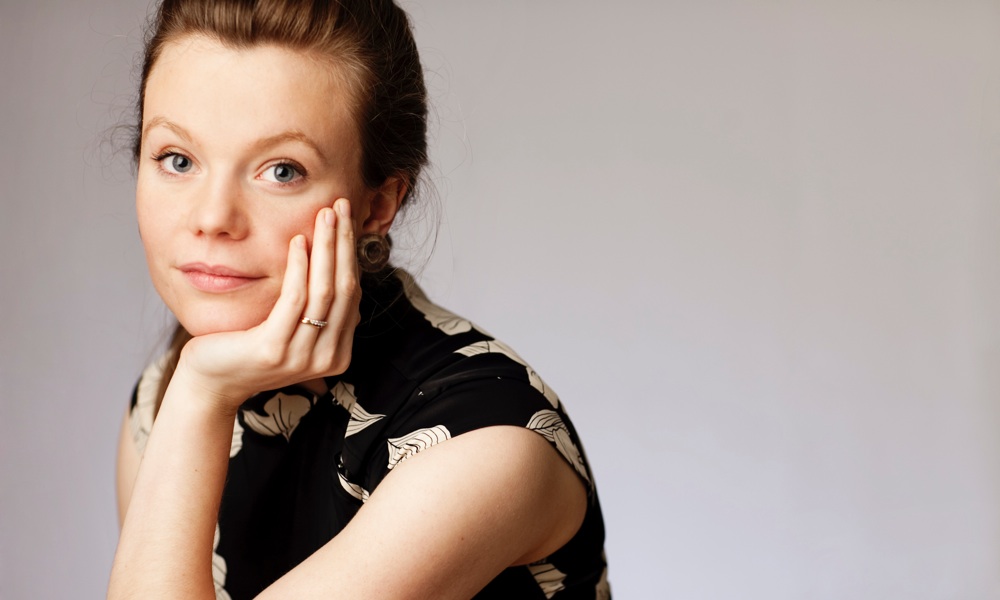
Clare Hammond
photo by Julie Kim
photo by Julie Kim
*
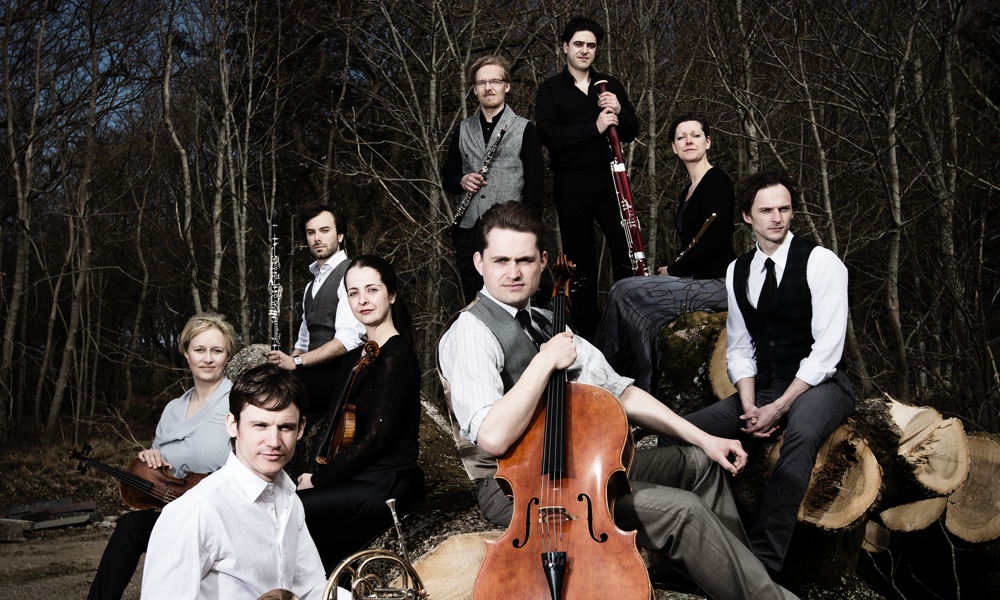
Ensemble Midtvest
photo by Nikolaj Lund
photo by Nikolaj Lund
Over five movements, and based on a memorable folk-like tune, Bruun painted the story of a young woman who falls asleep in the forest, dreams about a bird who offers her riches in return for the life of her unborn child, and who awakens to realise, with horror, that she has lost the child. Full of vivid textures that thickened and thinned by turn, the work combined rhythmic elongation and compression with unusual chord spacing to great effect – though I wish Bruun had resisted the urge for Psycho-like stabbing chords and a too-dominant high piccolo towards the close.
It was in this first concert ‘proper’ of the festival that Tavener was introduced, with a thoughtful rendition of his Little Missendom Calm (1984). From the venue’s balcony, oboe, clarinet and bassoon revolved harmonically together around a stately horn melody in simple two-bar phrases. It is a short and elegant piece, and was beautifully framed here by the UK première of Hans Abrahamsen’s alluring new arrangement of Ravel’s Le tombeau de Couperin and George Crumb’s wonderfully evocative Vox Balaenae (Voice of the Whale); a model of literal image-painting that yet manages to retain a wholly flowing and natural, abstract quality (how fantastic it would be to hear Crumb’s music explored in depth in a future Vale Festival!).
Abrahamsen is, of course, a leading Danish composer, and is well-known internationally as an initiator of ‘New Simplicity’ in the ‘60s and ‘70s, gradually evolving to a more overtly neo-romantic style. Perhaps unsurprisingly, it was his Ten Preludes for String Quartet (1973) that proved the high point of the evening – though this substantial work showed how rarely any label captures the live experiencing of a piece; here, with Abrahamsen’s fast-switching, expressive contrasts of mood via thrumming drones, syncopated, melodic fragments and far, far more. That the direct Baroque pastiche of the final prelude came as such a superb jolt indicated how unique and absorbing Abrahamsen’s soundworld is.
*
There were no such concerns in Tavener’s Song for Ileana (1988), for solo alto flute. Written for flautist Ileana Ruhemann, the poetic quotation which heads the work indicates its elegiac character: ‘Wherever I travel Greece wounds me’ (Seferis). Here, Charlotte Norholt brought out the music’s folk-like qualities, both intimate and suggestive of wider landscapes, with playing that was sensitive as well as full-toned. She and ‘cellist Jonathan Slaatto had already combined this lunchtime, for the first of two further UK premières from Bruun, here evocative of a landscape in southern Spain and named for its local mountain: Mojácar la Vieja (2011). The ‘ever-changing colours’ Bruun refers to in his programme note were certainly realised in this lyrical performance, from delicate cello pizzicato to a shared rocking theme and some lovely microtonal passages.
However, Bruun’s next piece, a string trio entitled The Black Waters (2012), was the stronger of the two, with its underlying depths and hints of a darker character which fully suited the composer’s combining of violin, viola and cello – in what can be a very tricky combination to write for. The alternately stopped and open strings of the beginning, the use of ambiguous major and minor thirds and the fresh, melodic overall feel added up to a most intriguing piece which I would very much like to hear again.
The last piece on the programme can, thankfully be heard any time, albeit on CD (recorded by the Calefax Reed Quintet). This was Abrahamsen’s 1978 wind quintet Walden; another substantial and thought-provoking piece. Consisting of four movements, the title – and indeed the pared-down content – alludes to Thoreau’s novel of 1854, in which the writer-philosopher described two years of living in a forest, attempting to ‘strip away all the artificial needs imposed by society and rediscover man’s lost unity with nature’ to quote the programme note. The resonances with Abrahamsen’s own striving for a new musical simplicity are clear – and were beautifully realised here with playing of great intensity and pure, uncluttered lines, which were yet never divorced from a warmth or engagement with the material. It was a fitting culmination to two excellent concerts by Ensemble MidtVest.
*
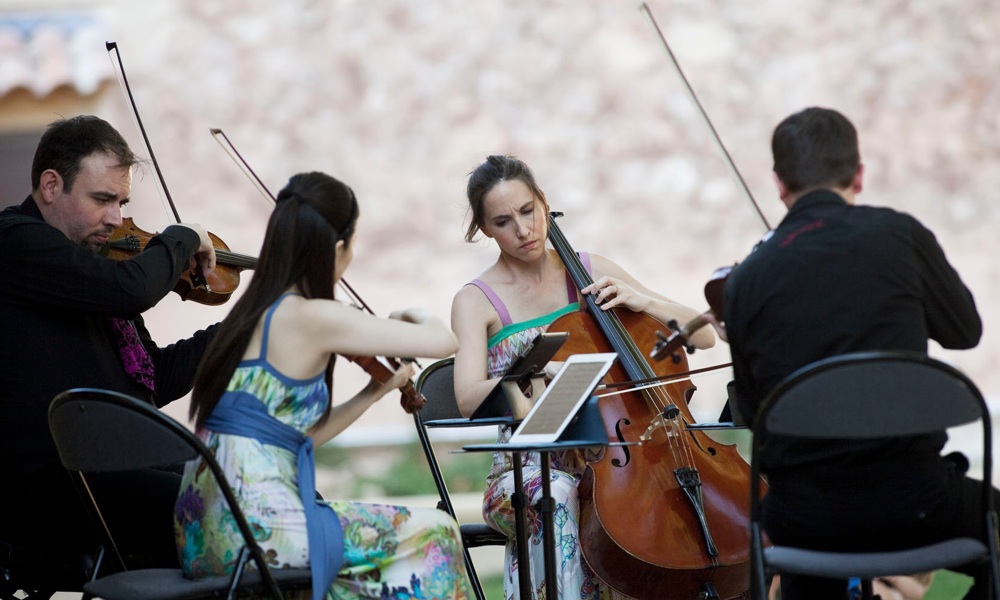
Quatour Tana
The quartet’s starting point here in Cardiff was deceptively innocuous, in Tavener’s tiny but powerful two-minute long Ikon of Joy and Sorrow (1999); the briefest of essays into the Orthodox composer’s famous desire to portray musical ‘icons in sound’ as gateways to the divine. The ambience was thoughtful, and Quatuor Tana’s stunningly controlled sound was suggestive of further, latent capabilities. The other miniature of the programme came with a lighter, jauntier flavour: O’Regan’s new piece for solo violin, Alice Changes (2014), was written for Thomas Gould and premiered by him on just March 30th. Here, the inspiration – if not the style directly – came from jazz (as you might expect for a piece premièred at Ronnie Scott’s), in the form of a series of figurations spun with increasing intricacy over the ‘same underlying chord progression [as] found in Charlie Parker’s “Blues for Alice”’. Tuneful double-stopping and a pizzicato/arco question and answer gave way to an engagingly meandering melody, with an eventual flourish to end.
In between these twin hommages to the featured composers of the festival, the quartet presented two UK premieres by Belgian composers. First came “Tuor Qua Tuor” (2008) by the 51 year-old composer, conductor and cellist Jean-Paul Dessy; akin to Tavener, but in his own way, an ardent proponent of music of all forms as a vehicle for sacred expression. As far as I understood first-violinist Antoine Maisonhaute, who did his best to explain it ahead of the quartet’s performance, the work’s title was a play on ‘Quatuor’; ‘tuor’ also meaning ‘sight’ in Latin, and referring to the work’s invitation for us to address our inner being, to ‘see’ as it were, ‘what we cannot see but only feel’. Certainly the air was of ethereal calm and introspection, with waves of repeated melodic fragments, glissandi and harmonics offering a kind of sonic balm in extension of the opening Tavener.
Beguiling though this was, the astonishing String Quartet No. 2, Summer Dreams (1994), by Philippe Boesman proved by far the profounder piece – to my ears at least. Here is a composer of real depth and stature, as well as quixotic invention. Cast in seven ‘dreams’, to say that Boesman’s quartet is teeming with extraordinary virtuosic effects is true, and yet totally inadequate to describe the brilliance and subtlety of his design. Bursts of sound alternate with sweet, tremulous melodies, delicate bird-like flittings turn to brief, impassioned dialogues, and throughout, there is the sense of a quartet unleashed and yet wholly together; chasing their own and each others’ tail without ever scattering or breaking apart. Fabulous music, fabulously played: a music of gestures that really do add up to something meaningful. But meaning what, you might ask? Well, perhaps that’s not really definable, nor even important beyond the sounds themselves – except to say that the dream and the nightmare were both thrillingly present.
Thursday, 5 March 2015
Dylan Thomas Centenary: BBC National Orchestra of Wales
The following was first published by Wales Arts Review, Volume 3, Issue 10, May 2014.
BBC Hoddinott Hall, Cardiff, 5 May 2014
Daniel Jones – Dance Fantasy
Alun Hoddinott – Clarinet Concerto No. 1
Mervyn Burtch – Four Portraits of Dylan Thomas
Igor Stravinsky – In memoriam Dylan Thomas
Aaron Copland – Appalachian Spring
BBC National Orchestra of Wales
Tenor: Robin Tritschler
Clarinet: Robert Plane
Conductor: Tecwyn Evans
In his book Remembering Poets, published in 1978, the distinguished American writer and editor Donald Hall remarked that ‘everyone knew Dylan Thomas’, the pub raconteur. He himself first met the poet at Harvard University in 1950, ‘before the fad or fashion for Thomas had begun’, to paraphrase his words. The occasion was a stop on Thomas’s first reading tour of America; an enterprise and a country to which the Welshman would, of course, return several times before his untimely death in Greenwich Village three years later. Accordingly, the music for this largely upbeat BBC National Orchestra of Wales concert was chosen to represent aspects of Thomas’s life both sides of the Atlantic, from precocious youth to those self-destructive later years.
The first half of the concert comprised works by one of Thomas’s closest and most longstanding friends, and two further Welsh compatriots, whilst the second reminded us of the libretto Thomas never got to write for that much-lamented, projected opera with Stravinsky. We have no way of knowing what would have emerged from a collaboration between these two cultural giants – and whether, as Stephen Walsh has also wondered, Stravinsky had really got the measure of Thomas’s unruly world-weariness – but I suspect the result would have been far removed from Copland’s Appalachian Spring; which inclusion on the programme seemed rather a sop to some vague, pastoral notion of ‘America’ than any real pointer to Thomas’s life or work.
Indeed, given that the context for this evening’s performance was a live, day-long transmission on BBC Radio 3 (in yet another Thomas centenary event), it seemed a missed opportunity not to have performed a work by someone from his London years; namely Thomas’s one-time landlady and sparring partner Elisabeth Lutyens. For both she and the poet were regular freelancers for BBC Radio and professional collaboration was often in the air, if only as fumes from the whisky they imbibed together.* Sadly though, Lutyens is as neglected as Thomas is lionised these days and her music would only be considered an audience draw in some other, far less timid, world.
So it is hugely to BBC NOW’s credit – albeit thanks to Tŷ Cerdd, Music Centre for Wales, who provided the commission – that this evening’s programme included the world premiere of a contemporary work; and by a Welshman, no less, whose music is by no means as spikily ‘difficult’ as Lutyens’ but who has long deserved a wider audience: the Ystrad Mynach-born Mervyn Burtch. His Four Portraits of Dylan were deft and touching in both colour and characterisation, and they were brilliantly played by the orchestra under conductor Tecwyn Evans. Burtch was born in 1929 – fifteen years after Thomas – and never met the poet, but grew up knowing his milieu, hangouts and, by reputation, his habits.
Cast in four sections, the work explored various aspects of Thomas from his youthful swagger and ever-loquacious wit (portrayed with a visual, almost cartoon-like flair) to the oft-blind searchings of the poet’s creative process. There were some lovely moments: the limpid woodwind theme of the second movement, the chugging, modal strings of the fourth, the cheeky slap-stick and temple block at points throughout; all presented with clear affection towards the poet from a composer who, moreover, happened to reveal an engagingly modest and youthfully curious character of his own in the process.
Burtch’s piece had been preceded by two works: Daniel Jones’s Dance Fantasy of 1976 and an early one by Burtch’s exact contemporary, Alun Hoddinott: the self-described ‘apprentice work’, Clarinet Concerto No. 1 of 1949-50 – written around the time Thomas first headed for the States. The Dance Fantasy got the evening off to a bright and vigorous start, whilst reminding us that Jones – whose own centenary passed in 2012 without anything like the fanfare accorded his dear friend – has yet to be fully appreciated as a composer of substance, either in Wales or further afield.
Alun Hoddinott is, of course, the deserving dedicatee of the excellent venue that is BBC Hoddinott Hall, and his music continues to be held in great esteem by many – though he, too, is said never to have met Dylan Thomas. No matter; the cultural-historical context was all, and there proved much to enjoy in the elegant, understated neoclassicism of his Clarinet Concerto No.1, albeit that Hoddinott himself quickly moved on from it stylistically. Soloist Robert Plane was on fine form this evening, producing by turn dramatic verve, dolefulness, and a liquid incisiveness that was matched by an orchestra of which he is clearly a popular and respected principal.
In the second half, Appalachian Spring may have been the intended culmination – and it was dispatched with characteristic aplomb, if not with quite the idiomatic, wide-open ‘Americana’ feel achieved by the BBC NOW in its recent series of that name – but it was Stravinsky’s preceding In memoriam Dylan Thomas which made the biggest impact. Hans Keller once described this setting of Thomas’s poem ‘Do not go gentle into that good night’ as Stravinsky’s ‘canonic masterpiece’, and so it felt here, in this excellent performance. Scored for a ravishing combination of tenor (the beautifully clear Robin Tritschler) string quartet and four trombones, the work is beguiling and keenly felt. Few would guess that its musical design is not only serial, but based on a five-note row that – to quote Keller again – ‘out-Schoenbergs Schoenberg’ in its tautness of melodic application. It was not merely a joy to hear the work, but the piece itself added a necessary element of depth and intimate gravitas to the evening’s proceedings.
* Lutyens was also a thwarted opera collaborator with Thomas. Around 1945-6, having worked with the poet on a number of radio plays, she requested a libretto from him but, in the words of Rhiannon Mathias, ‘he never quite managed to put pen to paper, despite a £50 advance.’ Like Stravinsky, Lutyens composed a piece upon Thomas’s death: the Valediction Op. 28, for clarinet and piano.
BBC Hoddinott Hall, Cardiff, 5 May 2014
Daniel Jones – Dance Fantasy
Alun Hoddinott – Clarinet Concerto No. 1
Mervyn Burtch – Four Portraits of Dylan Thomas
Igor Stravinsky – In memoriam Dylan Thomas
Aaron Copland – Appalachian Spring
BBC National Orchestra of Wales
Tenor: Robin Tritschler
Clarinet: Robert Plane
Conductor: Tecwyn Evans
In his book Remembering Poets, published in 1978, the distinguished American writer and editor Donald Hall remarked that ‘everyone knew Dylan Thomas’, the pub raconteur. He himself first met the poet at Harvard University in 1950, ‘before the fad or fashion for Thomas had begun’, to paraphrase his words. The occasion was a stop on Thomas’s first reading tour of America; an enterprise and a country to which the Welshman would, of course, return several times before his untimely death in Greenwich Village three years later. Accordingly, the music for this largely upbeat BBC National Orchestra of Wales concert was chosen to represent aspects of Thomas’s life both sides of the Atlantic, from precocious youth to those self-destructive later years.
The first half of the concert comprised works by one of Thomas’s closest and most longstanding friends, and two further Welsh compatriots, whilst the second reminded us of the libretto Thomas never got to write for that much-lamented, projected opera with Stravinsky. We have no way of knowing what would have emerged from a collaboration between these two cultural giants – and whether, as Stephen Walsh has also wondered, Stravinsky had really got the measure of Thomas’s unruly world-weariness – but I suspect the result would have been far removed from Copland’s Appalachian Spring; which inclusion on the programme seemed rather a sop to some vague, pastoral notion of ‘America’ than any real pointer to Thomas’s life or work.
Indeed, given that the context for this evening’s performance was a live, day-long transmission on BBC Radio 3 (in yet another Thomas centenary event), it seemed a missed opportunity not to have performed a work by someone from his London years; namely Thomas’s one-time landlady and sparring partner Elisabeth Lutyens. For both she and the poet were regular freelancers for BBC Radio and professional collaboration was often in the air, if only as fumes from the whisky they imbibed together.* Sadly though, Lutyens is as neglected as Thomas is lionised these days and her music would only be considered an audience draw in some other, far less timid, world.
So it is hugely to BBC NOW’s credit – albeit thanks to Tŷ Cerdd, Music Centre for Wales, who provided the commission – that this evening’s programme included the world premiere of a contemporary work; and by a Welshman, no less, whose music is by no means as spikily ‘difficult’ as Lutyens’ but who has long deserved a wider audience: the Ystrad Mynach-born Mervyn Burtch. His Four Portraits of Dylan were deft and touching in both colour and characterisation, and they were brilliantly played by the orchestra under conductor Tecwyn Evans. Burtch was born in 1929 – fifteen years after Thomas – and never met the poet, but grew up knowing his milieu, hangouts and, by reputation, his habits.
Cast in four sections, the work explored various aspects of Thomas from his youthful swagger and ever-loquacious wit (portrayed with a visual, almost cartoon-like flair) to the oft-blind searchings of the poet’s creative process. There were some lovely moments: the limpid woodwind theme of the second movement, the chugging, modal strings of the fourth, the cheeky slap-stick and temple block at points throughout; all presented with clear affection towards the poet from a composer who, moreover, happened to reveal an engagingly modest and youthfully curious character of his own in the process.
Burtch’s piece had been preceded by two works: Daniel Jones’s Dance Fantasy of 1976 and an early one by Burtch’s exact contemporary, Alun Hoddinott: the self-described ‘apprentice work’, Clarinet Concerto No. 1 of 1949-50 – written around the time Thomas first headed for the States. The Dance Fantasy got the evening off to a bright and vigorous start, whilst reminding us that Jones – whose own centenary passed in 2012 without anything like the fanfare accorded his dear friend – has yet to be fully appreciated as a composer of substance, either in Wales or further afield.
Alun Hoddinott is, of course, the deserving dedicatee of the excellent venue that is BBC Hoddinott Hall, and his music continues to be held in great esteem by many – though he, too, is said never to have met Dylan Thomas. No matter; the cultural-historical context was all, and there proved much to enjoy in the elegant, understated neoclassicism of his Clarinet Concerto No.1, albeit that Hoddinott himself quickly moved on from it stylistically. Soloist Robert Plane was on fine form this evening, producing by turn dramatic verve, dolefulness, and a liquid incisiveness that was matched by an orchestra of which he is clearly a popular and respected principal.
In the second half, Appalachian Spring may have been the intended culmination – and it was dispatched with characteristic aplomb, if not with quite the idiomatic, wide-open ‘Americana’ feel achieved by the BBC NOW in its recent series of that name – but it was Stravinsky’s preceding In memoriam Dylan Thomas which made the biggest impact. Hans Keller once described this setting of Thomas’s poem ‘Do not go gentle into that good night’ as Stravinsky’s ‘canonic masterpiece’, and so it felt here, in this excellent performance. Scored for a ravishing combination of tenor (the beautifully clear Robin Tritschler) string quartet and four trombones, the work is beguiling and keenly felt. Few would guess that its musical design is not only serial, but based on a five-note row that – to quote Keller again – ‘out-Schoenbergs Schoenberg’ in its tautness of melodic application. It was not merely a joy to hear the work, but the piece itself added a necessary element of depth and intimate gravitas to the evening’s proceedings.
* Lutyens was also a thwarted opera collaborator with Thomas. Around 1945-6, having worked with the poet on a number of radio plays, she requested a libretto from him but, in the words of Rhiannon Mathias, ‘he never quite managed to put pen to paper, despite a £50 advance.’ Like Stravinsky, Lutyens composed a piece upon Thomas’s death: the Valediction Op. 28, for clarinet and piano.
Wednesday, 4 March 2015
WNO's David Pountney in Conversation: Schoenberg, Verdi, and Issues of 'Faith'
The following was lead article of Wales Arts Review Volume 3, Issue 10, May 2014.
Welsh National Opera continue their themed seasons this summer with new productions of Schoenberg’s epic, unfinished masterpiece Moses und Aron and the opera that heralded the onset of Verdi’s creative maturity: Nabucco. The heading is ‘faith’ , so, of course, it is a contentious one, with clear contemporary resonances.
On the eve of the eagerly anticipated Moses und Aron first night at Cardiff’s Wales Millennium Centre (24 May), Wales Arts Review is proud to publish the latest conversation between WNO Artistic Director and CEO David Pountney and Steph Power. Here they explore various aspects of faith in relation to Moses und Aron and Schoenberg himself, but also in relation to Verdi and the twinning of the two operas.
Moses und Aron is directed by Jossi Wieler and Sergio Morabito, conducted by WNO Music Director Lothar Koenigs, and features Sir John Tomlinson as Moses. Nabucco is directed by Rudolf Frey and conducted by Xian Zhang and opens at the WMC on 31 May.
David Pountney is also directing a double bill, ‘The Fall of the House of Usher’ , at WNO this summer under the ‘British Firsts’ heading. The programme will comprise the UK première of a new version of Debussy’s La Chute de la Maison Usher by Robert Orledge, and the world stage première of Usher House by Gordon Getty. It will open, again at the WMC, on 13 June.
Steph Power: This summer will be a particularly enticing season at Welsh National Opera. I wonder if we might talk about the ‘faith’ theme, especially in regard to the Schoenberg? Moses may have been in the desert for forty days, but it’s nearly forty years since Moses und Aron was performed in the UK – it was 1976 when Deutsche Oper am Rhein took it to Edinburgh!
David Pountney: And it’s nearly fifty years since it was staged at Covent Garden, in 1965! I looked out my old programme of it the other day. I’ve even got it here actually.
To me it’s an extraordinary opera – an opera about ideas as much as anything – and an interesting contrast and yet complement to the Verdi. How did the ‘faith’ season come about?
Like all these things it was a mixture of serendipity and of fitting a rationale behind it. When I first came to Welsh National Opera, Lothar [WNO Music Director, Lothar Koenigs] flagged up his interest in doing Moses und Aron and I thought this was a sufficiently mad project to be taken quite seriously! I had to find somewhere a production that we could actually manage with our resources here; I did one myself in Munich about six or seven years ago, and there’s no way that that could have been put on at WNO because it used the full resources of that company, with dancers and extras and God knows what. Because obviously you can go in that direction.
But I found this production in Stuttgart which I thought was very intelligent and interesting, and which actually doesn’t use anything except the chorus. It was an ideal solution for us and made it possible to even think of doing the piece. Interestingly enough, if I’d programmed it in two years time we would not be doing it; that is to say you won’t see anything like this again in the next five years because of the way the funding situation is developing. So, opportunistically, I seized the right moment before anyone could notice that this was basically impossible!
Well, I salute you! What’s your view of the opera’s subject?
I actually have a rather controversial view about Moses. First of all, I think Moses is completely wrong. And I think it’s behoven to every intelligent, liberal intellectual person to resist and defy Moses with every ounce of your body and soul and mind and intellect! Because I think his prescriptive insistence that he knows the answer to whatever your faith might be is something quite horrific. And of course, to some extent, the same could be said of Schoenberg too – they’re a pair of arrogant bastards really! We have this rather sentimental idea that you’re supposed to admire or like the people you write about or put on theatre about. Actually I don’t think that’s true at all, it’s a rather naïve view. So it doesn’t belittle my respect for the originality of what Schoenberg achieved – or, indeed, even possibly what Moses was trying to say. I just don’t like being told by anybody that this is the only way to do it. And both men are, to some extent, guilty of that.
The interesting thing about Moses und Aron is that, because it was left unfinished by Schoenberg, we’re allowed to get away with a pseudo-tragic view of the piece because it ends up with Moses in despair saying, ‘O word, o word that I lack’. So we think, oh gosh poor chap, he’s struggling with this and so on. But of course that was not what Schoenberg had in mind; that was the ‘ending in doubt’ of the second act. In the third act, let’s not forget, Moses orders the murder of his brother Aron. [Schoenberg wrote the libretto for Act 3 but never set it to music despite his oft-stated intention to do so. Sometimes it’s performed as a spoken text following Act 2, though not by WNO in this production.] So he becomes a murderer actually and he then leads a march – and I use that word advisedly – of the Israeli people into the promised land. So Moses is a violent fundamentalist. To me he belongs up there with all these nutters capturing schoolgirls in Nigeria!
But do you think that Schoenberg – because I’ve pondered this myself – is actually more sympathetic to Aron in the piece than has often been painted? Or, to put it another way, is there at least room for Schoenberg to show any doubt of Moses? Perhaps it would be a self-doubt in part, as the parallel between Moses and Schoenberg is obvious; Schoenberg too struggled to deliver a ‘message’, so to speak, in serialism, and he became a sort of pariah figure for many beyond his own circle. Indeed, as far as the Nazis were concerned, he was a symbol of ‘degeneracy’.
Sympathy towards Aron is not something that I have perceived. It is of course true that Aron has more beautiful music but that’s part of the way in which he’s characterised by Schoenberg. It’s very instructive, in terms of Schoenberg and Moses’ intentions, to go back to the play that Schoenberg wrote prior to writing the opera.
Der Biblische Weg? [1926-7]
Yes. In the play there is a single character called Max Aruns who is obviously Moses and Aron in one person and who is essentially a Zionist. Actually, what the play is partly advocating is a kind of nationalist cult of physical fitness and aggression on behalf of the Jews. It’s a period in which the cult of nationalist violence – of a self-help vigilantism – was widespread; with the Nazis of course, but with others as well. For example, the Sokol movement in the Czech lands was a movement of physical fitness and health, and those people went around beating up Germans in the Sudetenland – which was part of the reason for the Germans protesting that they were being mistreated. And sometimes they were; it was not the case that the Germans were always the aggressors in this period. And Schoenberg really embraces this idea of vigilante nationalism on behalf of the Jews. Well, you could say that if everybody else is getting fit and punching noses then you’d better be armed in the same kind of way! But it’s interesting that he did advocate Jewish participation in such a movement.
I wonder if, from what you’re saying, and regarding the issue of image and representation of the divine, there’s an interesting subversion in the opera of the Nazis’ conflation of Judaism and modernism? Whether in some sense Schoenberg actually accepted that equation but turned it on its head to show, contra the idol-worshipping Nazis, that it’s the ‘worship’ of images that causes ‘degeneracy’ – not modernist values that do.
Yes, that’s his view. It seems to me an untenable view that image and representation necessarily leads to degeneracy, but that’s Moses’ view.
And to an extent Schoenberg’s? – That is, if one views serialism as a step away from representationalism and towards pure abstraction as some have argued, and as some later serialists tried to do?
Is it? I don’t think so. Serialism in itself is only really a technique to decide which notes to write down. If you want to represent a storm, or a cow mooing as Richard Strauss might have done, there’s nothing to stop you doing that within a 12-tone structure.
No indeed, as Berg did, and Henze and many others.
Yes. I’m sure you could point to lots of moments in the score of Moses und Aron where he’s choosing a particular colour in order to emphasise a point in the story, which is a kind of representationalism. So I don’t think you could really say that serialism of itself rules out or is in conflict with representation of non-musical ideas.
No, I agree. But that charge, if you like, of ‘abstraction’ – even of mathematical obsession – has pursued Schoenberg with regard to his 12-tone works; even though he said of serialism – apropos Moses und Aron as it happens – that you ‘use the method, but compose as before’. Is there something here too about Moses being a response to Parsifal? I’m thinking about Wagner’s attempts to represent the divine in that last opera: it seems interesting that, in Moses, Schoenberg uses serialism – the method he devised to organise pitch material in the wake of the breakdown of tonality from Wagner on – to argue for a taboo on images of the divine? If that makes sense?!
It does but I don’t get it. Surely, just to back track to what else Schoenberg said, he found himself using language that today we would identify immediately as being fascist language. He said ‘I think I have found a musical system that will guarantee the supremacy of German music’. Firstly, it’s interesting that he saw himself as a German composer – which he was. He’s basically implying that what was laid down by Bach had ensured the supremacy of German music for three centuries, but that what was laid down by Arnold was going to ensure that supremacy for the next three centuries! In which prediction he’s thankfully been proven to have been entirely wrong!
But it’s so fascinating that he would even think of the concept of supremacy in musical terms – that that would even occur to him as an idea. Vorherrschaft is the German word [literally pre-dominance, supremacy] and of course now it’s a word that nobody would use because it was totally tainted by the Nazis. But he used it and, even more importantly, he thought it.
So, there’s an irony here for Schoenberg, in terms of the taboo on divine images that Moses tries to instil; because Schoenberg himself has not only taken the legacy of a basically representational aesthetic on board, but he sees himself as in the vanguard of working for it to endure?
I suppose the point is that Moses, like Schoenberg, is a visionary who comes up with a new idea. But, ultimately, Moses is going to be prepared to murder the person who might compromise this idea – which is quite a frightening thought!
It is!
Going back to the point that you made about Aron – it would be very interesting to know how much this read to people at the time, in the early 1930s – but of course the concept of the demagogue became one of the catastrophic legacies of the Nazis. Because that’s the reason why, after the Second World War, the whole idea of writing anything popular became anathema; the taste of the people was associated with demagoguery. It was considered that if you pandered to the tastes of the people you were actually going down a fascist path. And I don’t know the extent to which Schoenberg identified Aron as a type of Goebbels.
The propagandist.
The propagandist. But he’s certainly playing that role isn’t he?
Yes indeed.
Of course, that really led to the whole catastrophe of post-war modernism, which led music off into a complete cul-de-sac for half a century, out of which we’re just emerging, with some relief!
Blinking in the light, perhaps!
– and with a substantially alienated public! Anyway, that’s just speculation really.
But what an interesting contrast to Verdi’s Nabucco, which embraces the popular – with Verdi himself in his day being so beloved of so many people, in stark contrast to Schoenberg’s later experience. Of course last year’s bicentenary of Verdi and Wagner led many to re-examine notions of a difference in sensibility between Italian and German opera, but it seems to me that, with Moses und Aron and Nabucco, it’s there and writ particularly large!
It’s colossal!
And it’s ironic too, given our conversation, that Mussolini did so much to try and popularise Verdi as a freedom figure.
Yes. Va pensiero [the famous Chorus of the Hebrews in Nabucco] was more or less adopted by the fascists as a second national anthem in Italy.
Going back to Moses und Aron, what does it mean to stage an opera that is effectively about – at least in part – the impossibility of images? Is that part of the challenge of putting it on? Although it seems to me that, despite Moses’ anguish at lacking the words to deliver his message, Schoenberg did find the words – that is, in those two acts at least, he managed to get something written and staged and voiced.
Yes – and surely Aron would point out that Moses’ despair was just as much an image as his own fluency and ability to demonstrate.
And the Voice from the Burning Bush is a hugely dramatic image.
Exactly. As is Moses’ gesture of breaking the tablets of stone. That’s showmanship too! And later, in the uncomposed third act, you could point to the execution of Aron as a very powerful image – pour encourager les autres!
So the opera is actually full of contradictions, right from the start.
Fundamentally, yes.
That in itself is interesting in terms of the spirals of contradiction and paradox that religious fundamentalists rely so much upon. Interesting that no such thing happens in the Verdi! There’s far more clear cut good and bad in Nabucco, with resolution thereof – though he’s still tackling very knotty issues at some level.
Yes – and there’s also the issue that fundamentalism, or your view of it, depends on which side you’re looking at it. For instance, Zaccaria happens to be the person who is able to lead his people – a bit like the Polish Pope [John Paul II]. But actually, if the Polish Pope had not had to lead the Poles to freedom from the communists, he would probably have been seen as a rather grumpy, right-wing religious fundamentalist! He acquires heroic status because of the situation that he was in, but actually, in terms of doctrine, he was quite a hardliner in fact. If you talk about his views on abortion, or women’s right to decide whether to have children or not, he comes over as a much less sympathetic figure than if you talk about his resistance to communism or to Soviet power and so on.
Completely!
I think if you met Zaccaria on another piece of territory, in another narrative, you might find that he was just as unpleasant as any other such figure.
So that issue of leadership becomes one, again, of representation – even of propaganda. There’s something about the tantrum that Moses has in the opera when he smashes the tablets.
Also an image of course, as we’ve said.
Exactly. For me that’s one of the most shockingly revealing parts of the piece – for what happens in that moment to Moses’ absolute mission to impart God’s Word? Somehow the personal ego asserts itself when the chips are down – and that’s very revealing about the nature of leadership and the will to power.
Yes. I guess the one thing that you could say in criticism of putting Nabucco under a title of ‘faith’ is that I’m not sure in the end that faith is the subject of Nabucco. It’s as much another of Verdi’s family dramas isn’t it?
Indeed.
And it’s got another of Verdi’s very powerful father-daughter conflicts or situations [as in Rigoletto for instance, most famously], with Abigail discovering that she’s illegitimate and blaming her father for that – which drives her to do all kinds of monstrous things.
Nabucco has also been painted as a very political opera in the sense that the oppressed Hebrews are often taken as a metaphor for the Italian people under the subjection of Austria. But I wonder how much that’s in retrospect; how far Verdi really was in his day a figure directly associated with the Risorgimento, and whether the opera’s story is more to do with his being a brilliant dramatist?
Oh I think he knew perfectly well that that would pull the right strings. He was a good theatre man and I think he knew what was going to stir people’s emotions – and that was a very powerful topic, even without it necessarily being identified with Garibaldi or the Risorgimento specifically. The opera is part of a big subject for the whole of Europe in the 19th century, which is the issue of national identification – right up to the point where the King of Egypt feels he has to commission an opera in order to establish the fact that Egypt is a grown-up nation; to have the opera tell the story! [The then Khedive of Egypt, Is’mail Pasha, later commissioned Verdi to write Aida.] Which applies all over Eastern Europe too of course.
I wonder if there is a faith aspect in Nabucco that happens to resonate with Schoenberg personally – which is the issue of religious conversion? [Schoenberg converted to Lutheranism as a young man and then back to Judaism upon having to flee Germany pre-war.] At least, your twinning of the two operas has got me thinking about that. Conversion is very powerful in the Verdi within that context of nationhood and imperialism and subjugation; the idea that one side in a conflict only really knows it has won when the other side accepts its God.
Right. Yes, it goes together with imperialism, with insisting that everybody thinks like you do. So it’s a decidedly illiberal agenda. Which is part of why I have problems with Moses himself, because I feel that those are all things that people should decide for themselves.
Moses is a very angry man somehow, as depicted in the opera. He’s angry with God for wanting him to be His mouthpiece. He knows he can’t do it, but approaches Aron with extremely bad grace – and immediately starts disagreeing with the way Aron wants to set about the task. So it’s not a straightforward case of ‘Moses loves God, Aron loves the people and ne’er the twain shall meet’, but all those very human emotions of anger and despair are very much part of the opera.
And I suppose jealousy too. I think Moses is quite jealous of Aron’s abilities and plausibility.
Yes – that contrast between Moses’ Sprechstimme [or sung-speech] and Aron’s eloquent bel canto is very powerful. And it’s interesting that God, through the chorus at the beginning, as the Voice from the Burning Bush, uses both Sprechstimme and song.
Right.
The chorus has a tremendously powerful role in the opera – and it’s very hard!
And they’re doing very well I think, too. That’s really the point of doing it here at WNO – to showcase the WNO Chorus.
Yes, I see that. Nabucco too is famous for its choruses – including, of course, Va pensiero. Another thing common to both operas in a way, seen in part through the chorus/crowd scenes, is the notion of cultural destruction. In the Verdi, there’s the destruction of the Hebrew temple, and then of the statue of Baal – another image.
Your saying that reminds me that you can see, in relation to Verdi’s life and career, how relatively primitive Nabucco is. Because there is no music for the destruction of Baal.
No! It slips through doesn’t it, without being ‘set’ by him.
Yes. And so I’m reminded of the fact that the attitude of the composer to a scenic event in Nabucco is the same as it was for Handel. When, in Xerxes, the bridge across the Hellespont collapses, there’s no music. Maybe the harpsichord does a kind of rumble or something – but there is nothing otherwise; the composer didn’t see it as his job to depict that kind of thing. In Nabucco, Verdi hasn’t quite noticed yet that the grand opéra has emerged in Paris, where people are beginning to compose all kinds of scenic effects: moonlight and thunderstorms.
Representing the image in music even!
Yes! And later on of course, with Verdi, when you think how he deals with the opening of Otello for example, he gets right in there. But he was writing in a different world in Nabucco.
And from that point of view also, it’s an interesting opera to twin with Moses because of the simultaneous dryness and yet huge expressivity that Schoenberg puts into that piece. He really goes for it with the Golden Calf music. I take it you’re not going to have people running through fires in that scene, as he writes in the score?!
No no! But I’m not sure I should give away the solution to all that! The fact that Jossi Wieler and Sergio Morabito in Stuttgart came up with a rather intelligent way of dealing with that scene was what made it possible for us to do the production!
No, don’t give it away! On the surface you look at those massive forces that Schoenberg employs and you think, this is epic opera, but it’s an opera as much about one man’s inner torment as it is epic on a grand scale like the Verdi. But again, the Verdi is also, as you say, a very personal drama.
Well you can see that as a parallel. Moses is about two brothers and a lot of the driving force of at least one side of the story in Nabucco are the two sisters and their very hostile relationship to one another.
Yes. Schoenberg seems to me to have been actually very interested in human relationships and the difficulties of, I suppose, being in the world. But he was caught in a bind because, on a personal level, he craved love and acceptance, but as a true modernist artist, he didn’t want either!
I think he wanted to be admired.
Yes – perhaps not ‘loved’. Revered.
Revered, yes. There’s another dreadful quote from him isn’t there? Something like ‘all art should be created cold’.
And yet his music wasn’t created cold. At least, I don’t think so!
It isn’t cold necessarily, but it may have been created cold – or the process may have been so. There’s another strange thing that is interesting to look at between the two pieces: I don’t think it’s any insult to Verdi to say that he actually cultivates simplicity. I think that’s very often what he meant by his concept of parola scenica [literally, the ‘scenic word’]; just the right, pithy way to bring a situation clearly onto the stage. But Schoenberg sets off what I think was a disastrous tendency in 20th century culture, of cultivating complexity – very often for its own sake.
You think so – even in Moses und Aron?
I think there is a kind of intellectual arrogance which is saying, if you can’t demonstrate utter mastery of an over-complexity, you’re not really qualified. I don’t think you can necessarily point to a bar in Moses und Aron and say look, you could have written that a lot simpler and got the same effect. But you can say that of the music of a lot of his followers.
Oh yes, that’s very true!
And so he established something – and maybe he shouldn’t be blamed for what less talented people did afterwards – but he established a kind of rule of thumb that complexity was important.
Perhaps there’s an arrogance in his using just one note-row as a basis for the whole opera in the way he did? In the sense of ‘look how I can write all of this music out of twelve notes arranged just so’? At any rate, that’s potentially rather fundamentalist in itself isn’t it?
It is, yes. But of course Bach would have done the same.
Perhaps without the self-consciousness?
Yes, without the self-consciousness.
Well thanks for talking with me David. I suspect I’d better let you go because you’ve got a rehearsal!
Yes I have. I can’t remember whether I’m rehearsing the simple piece or the complex piece! Because that’s quite an interesting contrast too! Getty’s piece is one of extreme simplicity you could say. He’s a tremendously nice man and very knowledgeable about opera. But I rather floored him the other day by saying that his piece was in the tradition of Dargomyzhsky. He’d never heard of Dargomyzhsky, which is fair enough – most people haven’t. But what Dargomyzhsky did – I don’t know whether you’ve heard of Dargomyzhsky?
Yes I have, he was a Russian composer, but carry on!
He created this idea of permanent recitative really. That is, that the function of the music was simply to illuminate the text and only under exceptional moments should the music rise up and say something on its own. And of course this technique was very influential on all the ‘Russian-Russian’ composers. By that I mean obviously not on Tchaikovsky, who’s the opposite; the ‘non-Russian’ composer. But on Mussorgsky in particular. This was very influential, and established this whole pattern of concentrating on the speech and reserving outright musical expression for very significant moments. And that’s basically what the Getty does. It’s just a very nuanced, careful handling of the text. Whereas the Debussy of course immediately gets into a sort of wallowing hot tub of misty perfumes and bath oils! So that’s an interesting contrast as well!
Yes it would be! I gather you’re doing a new version of the Debussy by Robert Orledge?
Well, it’s a version Robert Orledge did five years ago or so. We premièred it in Bregenz [an opera festival in Austria where David is Intendant], which is how I know it.
Well, I look forward to it, as well as to the Schoenberg and the Verdi. Thanks again for talking with me.
Thank you – it’s important to have serious discussion!
Welsh National Opera continue their themed seasons this summer with new productions of Schoenberg’s epic, unfinished masterpiece Moses und Aron and the opera that heralded the onset of Verdi’s creative maturity: Nabucco. The heading is ‘faith’ , so, of course, it is a contentious one, with clear contemporary resonances.
On the eve of the eagerly anticipated Moses und Aron first night at Cardiff’s Wales Millennium Centre (24 May), Wales Arts Review is proud to publish the latest conversation between WNO Artistic Director and CEO David Pountney and Steph Power. Here they explore various aspects of faith in relation to Moses und Aron and Schoenberg himself, but also in relation to Verdi and the twinning of the two operas.
Moses und Aron is directed by Jossi Wieler and Sergio Morabito, conducted by WNO Music Director Lothar Koenigs, and features Sir John Tomlinson as Moses. Nabucco is directed by Rudolf Frey and conducted by Xian Zhang and opens at the WMC on 31 May.
David Pountney is also directing a double bill, ‘The Fall of the House of Usher’ , at WNO this summer under the ‘British Firsts’ heading. The programme will comprise the UK première of a new version of Debussy’s La Chute de la Maison Usher by Robert Orledge, and the world stage première of Usher House by Gordon Getty. It will open, again at the WMC, on 13 June.
Steph Power: This summer will be a particularly enticing season at Welsh National Opera. I wonder if we might talk about the ‘faith’ theme, especially in regard to the Schoenberg? Moses may have been in the desert for forty days, but it’s nearly forty years since Moses und Aron was performed in the UK – it was 1976 when Deutsche Oper am Rhein took it to Edinburgh!
David Pountney: And it’s nearly fifty years since it was staged at Covent Garden, in 1965! I looked out my old programme of it the other day. I’ve even got it here actually.
To me it’s an extraordinary opera – an opera about ideas as much as anything – and an interesting contrast and yet complement to the Verdi. How did the ‘faith’ season come about?
Like all these things it was a mixture of serendipity and of fitting a rationale behind it. When I first came to Welsh National Opera, Lothar [WNO Music Director, Lothar Koenigs] flagged up his interest in doing Moses und Aron and I thought this was a sufficiently mad project to be taken quite seriously! I had to find somewhere a production that we could actually manage with our resources here; I did one myself in Munich about six or seven years ago, and there’s no way that that could have been put on at WNO because it used the full resources of that company, with dancers and extras and God knows what. Because obviously you can go in that direction.
But I found this production in Stuttgart which I thought was very intelligent and interesting, and which actually doesn’t use anything except the chorus. It was an ideal solution for us and made it possible to even think of doing the piece. Interestingly enough, if I’d programmed it in two years time we would not be doing it; that is to say you won’t see anything like this again in the next five years because of the way the funding situation is developing. So, opportunistically, I seized the right moment before anyone could notice that this was basically impossible!
Well, I salute you! What’s your view of the opera’s subject?
I actually have a rather controversial view about Moses. First of all, I think Moses is completely wrong. And I think it’s behoven to every intelligent, liberal intellectual person to resist and defy Moses with every ounce of your body and soul and mind and intellect! Because I think his prescriptive insistence that he knows the answer to whatever your faith might be is something quite horrific. And of course, to some extent, the same could be said of Schoenberg too – they’re a pair of arrogant bastards really! We have this rather sentimental idea that you’re supposed to admire or like the people you write about or put on theatre about. Actually I don’t think that’s true at all, it’s a rather naïve view. So it doesn’t belittle my respect for the originality of what Schoenberg achieved – or, indeed, even possibly what Moses was trying to say. I just don’t like being told by anybody that this is the only way to do it. And both men are, to some extent, guilty of that.
The interesting thing about Moses und Aron is that, because it was left unfinished by Schoenberg, we’re allowed to get away with a pseudo-tragic view of the piece because it ends up with Moses in despair saying, ‘O word, o word that I lack’. So we think, oh gosh poor chap, he’s struggling with this and so on. But of course that was not what Schoenberg had in mind; that was the ‘ending in doubt’ of the second act. In the third act, let’s not forget, Moses orders the murder of his brother Aron. [Schoenberg wrote the libretto for Act 3 but never set it to music despite his oft-stated intention to do so. Sometimes it’s performed as a spoken text following Act 2, though not by WNO in this production.] So he becomes a murderer actually and he then leads a march – and I use that word advisedly – of the Israeli people into the promised land. So Moses is a violent fundamentalist. To me he belongs up there with all these nutters capturing schoolgirls in Nigeria!
But do you think that Schoenberg – because I’ve pondered this myself – is actually more sympathetic to Aron in the piece than has often been painted? Or, to put it another way, is there at least room for Schoenberg to show any doubt of Moses? Perhaps it would be a self-doubt in part, as the parallel between Moses and Schoenberg is obvious; Schoenberg too struggled to deliver a ‘message’, so to speak, in serialism, and he became a sort of pariah figure for many beyond his own circle. Indeed, as far as the Nazis were concerned, he was a symbol of ‘degeneracy’.
Sympathy towards Aron is not something that I have perceived. It is of course true that Aron has more beautiful music but that’s part of the way in which he’s characterised by Schoenberg. It’s very instructive, in terms of Schoenberg and Moses’ intentions, to go back to the play that Schoenberg wrote prior to writing the opera.
Der Biblische Weg? [1926-7]
Yes. In the play there is a single character called Max Aruns who is obviously Moses and Aron in one person and who is essentially a Zionist. Actually, what the play is partly advocating is a kind of nationalist cult of physical fitness and aggression on behalf of the Jews. It’s a period in which the cult of nationalist violence – of a self-help vigilantism – was widespread; with the Nazis of course, but with others as well. For example, the Sokol movement in the Czech lands was a movement of physical fitness and health, and those people went around beating up Germans in the Sudetenland – which was part of the reason for the Germans protesting that they were being mistreated. And sometimes they were; it was not the case that the Germans were always the aggressors in this period. And Schoenberg really embraces this idea of vigilante nationalism on behalf of the Jews. Well, you could say that if everybody else is getting fit and punching noses then you’d better be armed in the same kind of way! But it’s interesting that he did advocate Jewish participation in such a movement.
I wonder if, from what you’re saying, and regarding the issue of image and representation of the divine, there’s an interesting subversion in the opera of the Nazis’ conflation of Judaism and modernism? Whether in some sense Schoenberg actually accepted that equation but turned it on its head to show, contra the idol-worshipping Nazis, that it’s the ‘worship’ of images that causes ‘degeneracy’ – not modernist values that do.
Yes, that’s his view. It seems to me an untenable view that image and representation necessarily leads to degeneracy, but that’s Moses’ view.
And to an extent Schoenberg’s? – That is, if one views serialism as a step away from representationalism and towards pure abstraction as some have argued, and as some later serialists tried to do?
Is it? I don’t think so. Serialism in itself is only really a technique to decide which notes to write down. If you want to represent a storm, or a cow mooing as Richard Strauss might have done, there’s nothing to stop you doing that within a 12-tone structure.
No indeed, as Berg did, and Henze and many others.
Yes. I’m sure you could point to lots of moments in the score of Moses und Aron where he’s choosing a particular colour in order to emphasise a point in the story, which is a kind of representationalism. So I don’t think you could really say that serialism of itself rules out or is in conflict with representation of non-musical ideas.
No, I agree. But that charge, if you like, of ‘abstraction’ – even of mathematical obsession – has pursued Schoenberg with regard to his 12-tone works; even though he said of serialism – apropos Moses und Aron as it happens – that you ‘use the method, but compose as before’. Is there something here too about Moses being a response to Parsifal? I’m thinking about Wagner’s attempts to represent the divine in that last opera: it seems interesting that, in Moses, Schoenberg uses serialism – the method he devised to organise pitch material in the wake of the breakdown of tonality from Wagner on – to argue for a taboo on images of the divine? If that makes sense?!
It does but I don’t get it. Surely, just to back track to what else Schoenberg said, he found himself using language that today we would identify immediately as being fascist language. He said ‘I think I have found a musical system that will guarantee the supremacy of German music’. Firstly, it’s interesting that he saw himself as a German composer – which he was. He’s basically implying that what was laid down by Bach had ensured the supremacy of German music for three centuries, but that what was laid down by Arnold was going to ensure that supremacy for the next three centuries! In which prediction he’s thankfully been proven to have been entirely wrong!
But it’s so fascinating that he would even think of the concept of supremacy in musical terms – that that would even occur to him as an idea. Vorherrschaft is the German word [literally pre-dominance, supremacy] and of course now it’s a word that nobody would use because it was totally tainted by the Nazis. But he used it and, even more importantly, he thought it.
So, there’s an irony here for Schoenberg, in terms of the taboo on divine images that Moses tries to instil; because Schoenberg himself has not only taken the legacy of a basically representational aesthetic on board, but he sees himself as in the vanguard of working for it to endure?
I suppose the point is that Moses, like Schoenberg, is a visionary who comes up with a new idea. But, ultimately, Moses is going to be prepared to murder the person who might compromise this idea – which is quite a frightening thought!
It is!
Going back to the point that you made about Aron – it would be very interesting to know how much this read to people at the time, in the early 1930s – but of course the concept of the demagogue became one of the catastrophic legacies of the Nazis. Because that’s the reason why, after the Second World War, the whole idea of writing anything popular became anathema; the taste of the people was associated with demagoguery. It was considered that if you pandered to the tastes of the people you were actually going down a fascist path. And I don’t know the extent to which Schoenberg identified Aron as a type of Goebbels.
The propagandist.
The propagandist. But he’s certainly playing that role isn’t he?
Yes indeed.
Of course, that really led to the whole catastrophe of post-war modernism, which led music off into a complete cul-de-sac for half a century, out of which we’re just emerging, with some relief!
Blinking in the light, perhaps!
– and with a substantially alienated public! Anyway, that’s just speculation really.
But what an interesting contrast to Verdi’s Nabucco, which embraces the popular – with Verdi himself in his day being so beloved of so many people, in stark contrast to Schoenberg’s later experience. Of course last year’s bicentenary of Verdi and Wagner led many to re-examine notions of a difference in sensibility between Italian and German opera, but it seems to me that, with Moses und Aron and Nabucco, it’s there and writ particularly large!
It’s colossal!
And it’s ironic too, given our conversation, that Mussolini did so much to try and popularise Verdi as a freedom figure.
Yes. Va pensiero [the famous Chorus of the Hebrews in Nabucco] was more or less adopted by the fascists as a second national anthem in Italy.
Going back to Moses und Aron, what does it mean to stage an opera that is effectively about – at least in part – the impossibility of images? Is that part of the challenge of putting it on? Although it seems to me that, despite Moses’ anguish at lacking the words to deliver his message, Schoenberg did find the words – that is, in those two acts at least, he managed to get something written and staged and voiced.
Yes – and surely Aron would point out that Moses’ despair was just as much an image as his own fluency and ability to demonstrate.
And the Voice from the Burning Bush is a hugely dramatic image.
Exactly. As is Moses’ gesture of breaking the tablets of stone. That’s showmanship too! And later, in the uncomposed third act, you could point to the execution of Aron as a very powerful image – pour encourager les autres!
So the opera is actually full of contradictions, right from the start.
Fundamentally, yes.
That in itself is interesting in terms of the spirals of contradiction and paradox that religious fundamentalists rely so much upon. Interesting that no such thing happens in the Verdi! There’s far more clear cut good and bad in Nabucco, with resolution thereof – though he’s still tackling very knotty issues at some level.
Yes – and there’s also the issue that fundamentalism, or your view of it, depends on which side you’re looking at it. For instance, Zaccaria happens to be the person who is able to lead his people – a bit like the Polish Pope [John Paul II]. But actually, if the Polish Pope had not had to lead the Poles to freedom from the communists, he would probably have been seen as a rather grumpy, right-wing religious fundamentalist! He acquires heroic status because of the situation that he was in, but actually, in terms of doctrine, he was quite a hardliner in fact. If you talk about his views on abortion, or women’s right to decide whether to have children or not, he comes over as a much less sympathetic figure than if you talk about his resistance to communism or to Soviet power and so on.
Completely!
I think if you met Zaccaria on another piece of territory, in another narrative, you might find that he was just as unpleasant as any other such figure.
So that issue of leadership becomes one, again, of representation – even of propaganda. There’s something about the tantrum that Moses has in the opera when he smashes the tablets.
Also an image of course, as we’ve said.
Exactly. For me that’s one of the most shockingly revealing parts of the piece – for what happens in that moment to Moses’ absolute mission to impart God’s Word? Somehow the personal ego asserts itself when the chips are down – and that’s very revealing about the nature of leadership and the will to power.
Yes. I guess the one thing that you could say in criticism of putting Nabucco under a title of ‘faith’ is that I’m not sure in the end that faith is the subject of Nabucco. It’s as much another of Verdi’s family dramas isn’t it?
Indeed.
And it’s got another of Verdi’s very powerful father-daughter conflicts or situations [as in Rigoletto for instance, most famously], with Abigail discovering that she’s illegitimate and blaming her father for that – which drives her to do all kinds of monstrous things.
Nabucco has also been painted as a very political opera in the sense that the oppressed Hebrews are often taken as a metaphor for the Italian people under the subjection of Austria. But I wonder how much that’s in retrospect; how far Verdi really was in his day a figure directly associated with the Risorgimento, and whether the opera’s story is more to do with his being a brilliant dramatist?
Oh I think he knew perfectly well that that would pull the right strings. He was a good theatre man and I think he knew what was going to stir people’s emotions – and that was a very powerful topic, even without it necessarily being identified with Garibaldi or the Risorgimento specifically. The opera is part of a big subject for the whole of Europe in the 19th century, which is the issue of national identification – right up to the point where the King of Egypt feels he has to commission an opera in order to establish the fact that Egypt is a grown-up nation; to have the opera tell the story! [The then Khedive of Egypt, Is’mail Pasha, later commissioned Verdi to write Aida.] Which applies all over Eastern Europe too of course.
I wonder if there is a faith aspect in Nabucco that happens to resonate with Schoenberg personally – which is the issue of religious conversion? [Schoenberg converted to Lutheranism as a young man and then back to Judaism upon having to flee Germany pre-war.] At least, your twinning of the two operas has got me thinking about that. Conversion is very powerful in the Verdi within that context of nationhood and imperialism and subjugation; the idea that one side in a conflict only really knows it has won when the other side accepts its God.
Right. Yes, it goes together with imperialism, with insisting that everybody thinks like you do. So it’s a decidedly illiberal agenda. Which is part of why I have problems with Moses himself, because I feel that those are all things that people should decide for themselves.
Moses is a very angry man somehow, as depicted in the opera. He’s angry with God for wanting him to be His mouthpiece. He knows he can’t do it, but approaches Aron with extremely bad grace – and immediately starts disagreeing with the way Aron wants to set about the task. So it’s not a straightforward case of ‘Moses loves God, Aron loves the people and ne’er the twain shall meet’, but all those very human emotions of anger and despair are very much part of the opera.
And I suppose jealousy too. I think Moses is quite jealous of Aron’s abilities and plausibility.
Yes – that contrast between Moses’ Sprechstimme [or sung-speech] and Aron’s eloquent bel canto is very powerful. And it’s interesting that God, through the chorus at the beginning, as the Voice from the Burning Bush, uses both Sprechstimme and song.
Right.
The chorus has a tremendously powerful role in the opera – and it’s very hard!
And they’re doing very well I think, too. That’s really the point of doing it here at WNO – to showcase the WNO Chorus.
Yes, I see that. Nabucco too is famous for its choruses – including, of course, Va pensiero. Another thing common to both operas in a way, seen in part through the chorus/crowd scenes, is the notion of cultural destruction. In the Verdi, there’s the destruction of the Hebrew temple, and then of the statue of Baal – another image.
Your saying that reminds me that you can see, in relation to Verdi’s life and career, how relatively primitive Nabucco is. Because there is no music for the destruction of Baal.
No! It slips through doesn’t it, without being ‘set’ by him.
Yes. And so I’m reminded of the fact that the attitude of the composer to a scenic event in Nabucco is the same as it was for Handel. When, in Xerxes, the bridge across the Hellespont collapses, there’s no music. Maybe the harpsichord does a kind of rumble or something – but there is nothing otherwise; the composer didn’t see it as his job to depict that kind of thing. In Nabucco, Verdi hasn’t quite noticed yet that the grand opéra has emerged in Paris, where people are beginning to compose all kinds of scenic effects: moonlight and thunderstorms.
Representing the image in music even!
Yes! And later on of course, with Verdi, when you think how he deals with the opening of Otello for example, he gets right in there. But he was writing in a different world in Nabucco.
And from that point of view also, it’s an interesting opera to twin with Moses because of the simultaneous dryness and yet huge expressivity that Schoenberg puts into that piece. He really goes for it with the Golden Calf music. I take it you’re not going to have people running through fires in that scene, as he writes in the score?!
No no! But I’m not sure I should give away the solution to all that! The fact that Jossi Wieler and Sergio Morabito in Stuttgart came up with a rather intelligent way of dealing with that scene was what made it possible for us to do the production!
No, don’t give it away! On the surface you look at those massive forces that Schoenberg employs and you think, this is epic opera, but it’s an opera as much about one man’s inner torment as it is epic on a grand scale like the Verdi. But again, the Verdi is also, as you say, a very personal drama.
Well you can see that as a parallel. Moses is about two brothers and a lot of the driving force of at least one side of the story in Nabucco are the two sisters and their very hostile relationship to one another.
Yes. Schoenberg seems to me to have been actually very interested in human relationships and the difficulties of, I suppose, being in the world. But he was caught in a bind because, on a personal level, he craved love and acceptance, but as a true modernist artist, he didn’t want either!
I think he wanted to be admired.
Yes – perhaps not ‘loved’. Revered.
Revered, yes. There’s another dreadful quote from him isn’t there? Something like ‘all art should be created cold’.
And yet his music wasn’t created cold. At least, I don’t think so!
It isn’t cold necessarily, but it may have been created cold – or the process may have been so. There’s another strange thing that is interesting to look at between the two pieces: I don’t think it’s any insult to Verdi to say that he actually cultivates simplicity. I think that’s very often what he meant by his concept of parola scenica [literally, the ‘scenic word’]; just the right, pithy way to bring a situation clearly onto the stage. But Schoenberg sets off what I think was a disastrous tendency in 20th century culture, of cultivating complexity – very often for its own sake.
You think so – even in Moses und Aron?
I think there is a kind of intellectual arrogance which is saying, if you can’t demonstrate utter mastery of an over-complexity, you’re not really qualified. I don’t think you can necessarily point to a bar in Moses und Aron and say look, you could have written that a lot simpler and got the same effect. But you can say that of the music of a lot of his followers.
Oh yes, that’s very true!
And so he established something – and maybe he shouldn’t be blamed for what less talented people did afterwards – but he established a kind of rule of thumb that complexity was important.
Perhaps there’s an arrogance in his using just one note-row as a basis for the whole opera in the way he did? In the sense of ‘look how I can write all of this music out of twelve notes arranged just so’? At any rate, that’s potentially rather fundamentalist in itself isn’t it?
It is, yes. But of course Bach would have done the same.
Perhaps without the self-consciousness?
Yes, without the self-consciousness.
Well thanks for talking with me David. I suspect I’d better let you go because you’ve got a rehearsal!
Yes I have. I can’t remember whether I’m rehearsing the simple piece or the complex piece! Because that’s quite an interesting contrast too! Getty’s piece is one of extreme simplicity you could say. He’s a tremendously nice man and very knowledgeable about opera. But I rather floored him the other day by saying that his piece was in the tradition of Dargomyzhsky. He’d never heard of Dargomyzhsky, which is fair enough – most people haven’t. But what Dargomyzhsky did – I don’t know whether you’ve heard of Dargomyzhsky?
Yes I have, he was a Russian composer, but carry on!
He created this idea of permanent recitative really. That is, that the function of the music was simply to illuminate the text and only under exceptional moments should the music rise up and say something on its own. And of course this technique was very influential on all the ‘Russian-Russian’ composers. By that I mean obviously not on Tchaikovsky, who’s the opposite; the ‘non-Russian’ composer. But on Mussorgsky in particular. This was very influential, and established this whole pattern of concentrating on the speech and reserving outright musical expression for very significant moments. And that’s basically what the Getty does. It’s just a very nuanced, careful handling of the text. Whereas the Debussy of course immediately gets into a sort of wallowing hot tub of misty perfumes and bath oils! So that’s an interesting contrast as well!
Yes it would be! I gather you’re doing a new version of the Debussy by Robert Orledge?
Well, it’s a version Robert Orledge did five years ago or so. We premièred it in Bregenz [an opera festival in Austria where David is Intendant], which is how I know it.
Well, I look forward to it, as well as to the Schoenberg and the Verdi. Thanks again for talking with me.
Thank you – it’s important to have serious discussion!
Saturday, 28 February 2015
Basel Symphony Orchestra: 'Three Minimalist Classics' by Pärt, Glass, Adams.
The following was first published in Wales Arts Review, Volume 3 Issue 9, May 2014.
St David’s Hall, Cardiff, 29 April 2014
Arvo Pärt – “These Words …”
Philip Glass – Cello Concerto No. 2 ‘Naqoyqatsi’
John Adams – Harmonielehre
Basel Symphony Orchestra Cello: Matt Haimovitz Conductor: Dennis Russell Davies
It is several decades since Michael Nyman and others first alighted on the term ‘minimalism’ in the late Sixties to describe the musical phenomenon then emerging from the USA and elsewhere as a parallel to recent developments in the visual arts. Not so much a style as a sensibility, this new music sent shockwaves through the academic establishment with its simple tonality, hypnotic repetition of melodic and rhythmic patterns, emphasis on process rather than motivic development and, above all, its overturning of the teleological assumptions that had characterised Western music for centuries. For those people struggling to navigate the seemingly esoteric complexities of much new music at the time – in contrast to the rising rock and pop culture – encountering the likes of Steve Reich, Philip Glass and Terry Riley in the Seventies was nothing short of mind-blowing. These and other equally individual composers were initially dismissed as enfants terrible, but together they went on to drastically alter the so-called ‘classical’ music landscape.
However, as with all loose descriptors that are seized on and become labels, the term minimalism quickly became stale for many of the composers to whom it was applied: Glass revealing his frustration with it as early as 1980, when he declared, ‘I think the word [“minimal”] should be stamped out!’ Moreover, such is the way of revolution that what was once new and liberating becomes the new orthodoxy and thence becomes history; where it continues today, minimalism is by and large very much part of the establishment, and its originators are now considered the old guard. Nevertheless, minimalism was a hugely positive development in many respects and its influence is still clearly felt. Not only did it shake loose many antiquated classical music conventions but, as Paul Hillier points out in an interview elsewhere in this edition of Wales Arts Review, it opened up different areas of classical music for new audiences to enjoy.
That minimalism was always a broad term to anyone beyond certain purists and critics is evidenced by John Adams’ inclusion in this intriguing concert, advertised as ‘three minimalist classics’, by the Basel Symphony Orchestra. Indeed, if labels are to be used at all, then Adams’ Harmonielehre, which formed the high point of the evening, is not so much minimalist as neo-Romantic; an entirely different kettle of chords, so to speak, in its post-19th century chromatic harmony and emotional expressivity. Given the charges of betrayal directed at Adams following the work’s premiere in 1985, it therefore seems doubly ironic that Harmonielehre should have been the only true ‘classic’ on this Cardiff programme. For the piece was written in response to Adams’ own struggle with minimalism, as the title – taken from Schoenberg’s influential 1911 textbook on harmony – suggests.
Today, of course, minimalist or otherwise, Harmonielehre is firmly accepted in the orchestral canon – and rightly so, as it is an extraordinary piece; utterly individual and yet managing to reference composers as diverse as Wagner, Mahler, Debussy and Stravinsky in a profound symphonic journey through aesthetic crisis to breakthrough and renewal. This evening’s performance, conducted by minimalist interpreter extraordinaire, Dennis Russell Davies, brought Adams’ glimmering textures and rollercoaster momentum surgingly to life. From the walloping E minor chords of the first movement, to the eerie dissolving and coalescing of the second movement (The Amfortas Wound) and the brilliant, almost pointillist, orchestral richness of the third (Meister Eckhardt and Quakie), there was both grandeur and delicacy aplenty from this excellent orchestra, here making its Welsh debut.
Clearly, both the orchestra and their artistic director of some five years know this piece inside out, and they plunged beneath its seething surface to produce the depth of sound so crucial to Adams’ lavish, yet translucent scoring. But for all that, I had the feeling that the players were showing signs of wear as they drew towards the end of their punishing UK tour; this being the penultimate of seven concerts presenting four separate concert programmes within a week. Not that there was anything overtly wrong or lacking in the performance, just the quiet sense that the orchestra was not as on fire as it might have been.
Still, the players had already acquitted themselves with distinction in the first half – and perhaps a fuller audience might have encouraged them further. As it was, both the Pärt and the Glass were extremely well played. Arvo Pärt is, of course, oft-saddled with the usually pejorative ‘holy minimalist’ label due to the mysticism and devotion to matters of Orthodox belief that permeate his music, as well as its apparent simplicity. That this is both misleading and unhelpful would require too much space to unravel here; suffice it to say that the composer has achieved huge popularity despite this – though it is high time that other fine Estonian composers were allowed to do more than peep out from behind his coat-tails. “These Words …” was full of Pärt’s characteristic and highly appealing resonant stillness, and would make an enticing introduction to his 4th Symphony of 2008-9, which utilises its material in the second movement, to those unfamiliar with the longer work.
Glass is another composer suffering from over-exposure in my view these days, but his music remains strangely compelling, and often refreshing to hear live, no matter that he has long since become predictable and almost literally self-perpetuating. Indeed, English National Opera’s revival of his opera Satyagraha last year was stunning in all departments. The Cello Concerto No. 2 performed here in Cardiff scaled no such heights but was given a warm and lyrical rendition by soloist Matt Haimovitz. All told, at forty minutes, the piece teetered on the edge of overlong, but Haimovitz and the orchestra just about held the interest through the seven sections; a symmetrical – and non-programmatic – arrangement of material taken from Glass’s score to the 2002 film Naqoyqatski (the third of the Qatsi trilogy documenting the relationship between humans, technology and nature). Elder statesman of ‘minimalism’ he might be despite his protests, but there is no sign yet of Glass either altering his style, or of slowing his prodigious output.
St David’s Hall, Cardiff, 29 April 2014
Arvo Pärt – “These Words …”
Philip Glass – Cello Concerto No. 2 ‘Naqoyqatsi’
John Adams – Harmonielehre
Basel Symphony Orchestra Cello: Matt Haimovitz Conductor: Dennis Russell Davies
It is several decades since Michael Nyman and others first alighted on the term ‘minimalism’ in the late Sixties to describe the musical phenomenon then emerging from the USA and elsewhere as a parallel to recent developments in the visual arts. Not so much a style as a sensibility, this new music sent shockwaves through the academic establishment with its simple tonality, hypnotic repetition of melodic and rhythmic patterns, emphasis on process rather than motivic development and, above all, its overturning of the teleological assumptions that had characterised Western music for centuries. For those people struggling to navigate the seemingly esoteric complexities of much new music at the time – in contrast to the rising rock and pop culture – encountering the likes of Steve Reich, Philip Glass and Terry Riley in the Seventies was nothing short of mind-blowing. These and other equally individual composers were initially dismissed as enfants terrible, but together they went on to drastically alter the so-called ‘classical’ music landscape.
However, as with all loose descriptors that are seized on and become labels, the term minimalism quickly became stale for many of the composers to whom it was applied: Glass revealing his frustration with it as early as 1980, when he declared, ‘I think the word [“minimal”] should be stamped out!’ Moreover, such is the way of revolution that what was once new and liberating becomes the new orthodoxy and thence becomes history; where it continues today, minimalism is by and large very much part of the establishment, and its originators are now considered the old guard. Nevertheless, minimalism was a hugely positive development in many respects and its influence is still clearly felt. Not only did it shake loose many antiquated classical music conventions but, as Paul Hillier points out in an interview elsewhere in this edition of Wales Arts Review, it opened up different areas of classical music for new audiences to enjoy.
That minimalism was always a broad term to anyone beyond certain purists and critics is evidenced by John Adams’ inclusion in this intriguing concert, advertised as ‘three minimalist classics’, by the Basel Symphony Orchestra. Indeed, if labels are to be used at all, then Adams’ Harmonielehre, which formed the high point of the evening, is not so much minimalist as neo-Romantic; an entirely different kettle of chords, so to speak, in its post-19th century chromatic harmony and emotional expressivity. Given the charges of betrayal directed at Adams following the work’s premiere in 1985, it therefore seems doubly ironic that Harmonielehre should have been the only true ‘classic’ on this Cardiff programme. For the piece was written in response to Adams’ own struggle with minimalism, as the title – taken from Schoenberg’s influential 1911 textbook on harmony – suggests.
Today, of course, minimalist or otherwise, Harmonielehre is firmly accepted in the orchestral canon – and rightly so, as it is an extraordinary piece; utterly individual and yet managing to reference composers as diverse as Wagner, Mahler, Debussy and Stravinsky in a profound symphonic journey through aesthetic crisis to breakthrough and renewal. This evening’s performance, conducted by minimalist interpreter extraordinaire, Dennis Russell Davies, brought Adams’ glimmering textures and rollercoaster momentum surgingly to life. From the walloping E minor chords of the first movement, to the eerie dissolving and coalescing of the second movement (The Amfortas Wound) and the brilliant, almost pointillist, orchestral richness of the third (Meister Eckhardt and Quakie), there was both grandeur and delicacy aplenty from this excellent orchestra, here making its Welsh debut.
Clearly, both the orchestra and their artistic director of some five years know this piece inside out, and they plunged beneath its seething surface to produce the depth of sound so crucial to Adams’ lavish, yet translucent scoring. But for all that, I had the feeling that the players were showing signs of wear as they drew towards the end of their punishing UK tour; this being the penultimate of seven concerts presenting four separate concert programmes within a week. Not that there was anything overtly wrong or lacking in the performance, just the quiet sense that the orchestra was not as on fire as it might have been.
Still, the players had already acquitted themselves with distinction in the first half – and perhaps a fuller audience might have encouraged them further. As it was, both the Pärt and the Glass were extremely well played. Arvo Pärt is, of course, oft-saddled with the usually pejorative ‘holy minimalist’ label due to the mysticism and devotion to matters of Orthodox belief that permeate his music, as well as its apparent simplicity. That this is both misleading and unhelpful would require too much space to unravel here; suffice it to say that the composer has achieved huge popularity despite this – though it is high time that other fine Estonian composers were allowed to do more than peep out from behind his coat-tails. “These Words …” was full of Pärt’s characteristic and highly appealing resonant stillness, and would make an enticing introduction to his 4th Symphony of 2008-9, which utilises its material in the second movement, to those unfamiliar with the longer work.
Glass is another composer suffering from over-exposure in my view these days, but his music remains strangely compelling, and often refreshing to hear live, no matter that he has long since become predictable and almost literally self-perpetuating. Indeed, English National Opera’s revival of his opera Satyagraha last year was stunning in all departments. The Cello Concerto No. 2 performed here in Cardiff scaled no such heights but was given a warm and lyrical rendition by soloist Matt Haimovitz. All told, at forty minutes, the piece teetered on the edge of overlong, but Haimovitz and the orchestra just about held the interest through the seven sections; a symmetrical – and non-programmatic – arrangement of material taken from Glass’s score to the 2002 film Naqoyqatski (the third of the Qatsi trilogy documenting the relationship between humans, technology and nature). Elder statesman of ‘minimalism’ he might be despite his protests, but there is no sign yet of Glass either altering his style, or of slowing his prodigious output.
Subscribe to:
Posts (Atom)